AI Appraisal Estimate

AI-generated estimates · not official valuations

From the user

What was submitted

Photo and notes provided by the user — not generated by AI

Submitted item photo
Submitted photo · June 8, 2026

User's notes

Chinese ritual

AI analysis below

AI appraisal

AI analysis & estimate

AI-Generated · Verify before acting

Everything below is generated by AI for informational purposes only. AI can make mistakes — the AI may misidentify items or misattribute them (artist, maker, brand, designer, origin, era). This is not an official valuation and should not be used for insurance, sale, tax, estate, legal, or lending purposes — or any decision requiring a certified appraisal. It is not an authoritative claim about any person, brand, or rights holder — do not share or rely on it as a factual statement about a third party. Always consult qualified professionals before making financial decisions.

Note

This analysis also relies on unverified notes provided by the user, which may be incomplete or inaccurate and could affect the result.

Read the full disclaimer

AI Identification

·Not independently authenticated·Verify before acting

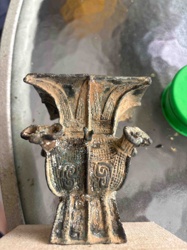
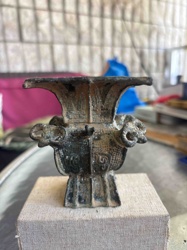
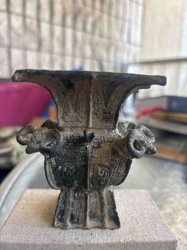
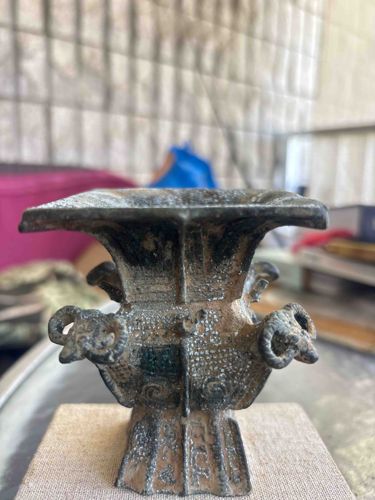
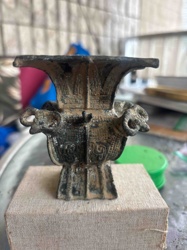
Archaic Chinese Bronze Zun Vessel with Ram Heads

Chinese Ritual Bronze Vessel

AI Estimated Value

·Not an official valuation·Verify before acting

$600,000 - $900,000

As of June 8, 2026

AI Item Analysis

·AI can make mistakes·Verify before acting
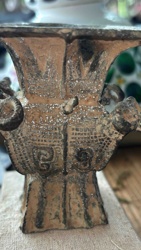
This item is an archaic Chinese bronze ritual vessel, specifically a zun, characterized by its distinctive flared mouth, constricted waist, and robust foot. The vessel is constructed from bronze, exhibiting a rich, dark brown and mottled surface with areas of greenish-blue patina, indicative of significant age and exposure to environmental elements. The surface texture appears granular and pitted in places, suggesting corrosion consistent with ancient buried bronzes. A notable feature is the presence of four stylized ram or ibex heads projecting from the middle section of the body, two of which are clearly visible in the provided image. These animal heads are rendered in high relief, complete with curled horns and detailed facial features. The body of the vessel is adorned with intricate patterns, including what appears to be a 'leiwen' (thunder pattern) background fill, giving texture and depth to the surface, and possibly 'taotie' mask motifs, though not explicitly clear from the angle. The foot of the vessel is flared and segmented into four broad, flat sections, echoing the overall geometric design. The quality of craftsmanship is high, with precise casting evident in the sharp lines and detailed animal figures. The overall condition suggests authenticity as an ancient artifact, with natural wear, burial patination, and minor surface inconsistencies. No obvious repairs or modern markings are discernible from the image. This type of vessel is typical of the Shang or early Western Zhou dynasty, placing its estimated age between the 16th to 8th century BCE. The robust construction and elaborate zoomorphic decorations are characteristic of ritual bronzes used during these periods for ancestor worship and other ceremonial practices.
AI Appraisal Report

·AI can make mistakes·Verify before acting
Upon examining the provided image of this Archaic Chinese Bronze Zun Vessel with Ram Heads, its condition appears consistent with a genuine ancient artifact. The rich, dark brown and mottled surface, along with areas of greenish-blue patina and granular pitting, strongly suggest authentic burial characteristics and significant age. The high-relief ram heads, intricate patterns, and precise casting indicate exceptional craftsmanship typical of Shang or early Western Zhou ritual bronzes. I observe no obvious repairs or modern alterations from the image provided. Market conditions for top-tier Archaic Chinese bronzes are robust, with a consistent demand from international collectors and institutions. Comparable zun vessels of this quality and period, particularly those with auspicious animal motifs, have achieved substantial prices at major auction houses (e.g., Christie's and Sotheby's). The rarity of such well-preserved and aesthetically significant examples further drives value. Factors positively impacting its worth include its antiquity (estimated 16th to 8th century BCE), remarkable condition for its age, and the zoomorphic decoration. Due to the prevalence of sophisticated forgeries, definitive authentication based *solely* on images is naturally limited. A full in-person examination, including tactile assessment of surface texture, patina analysis under magnification, and metallurgical testing (e.g., XRF analysis) to confirm alloy composition and casting techniques, would be crucial. Furthermore, detailed provenance documentation, tracing its ownership history, is indispensable for solidifying its authenticity and maximizing its market value.

Get your items appraised

Instant estimates of your treasures with AI-powered appraisals

Browse More Appraisals