AI estimate as of November 23, 2025 · verify with a professional before acting
AI-Generated · Verify before acting
Everything on this page is generated by AI for informational purposes only. AI can make mistakes — the AI may misidentify items or misattribute them (artist, maker, brand, designer, origin, era). This is not an official valuation and should not be used for insurance, sale, tax, estate, legal, or lending purposes — or any decision requiring a certified appraisal. It is not an authoritative claim about any person, brand, or rights holder — do not share or rely on it as a factual statement about a third party. Always consult qualified professionals before making financial decisions.
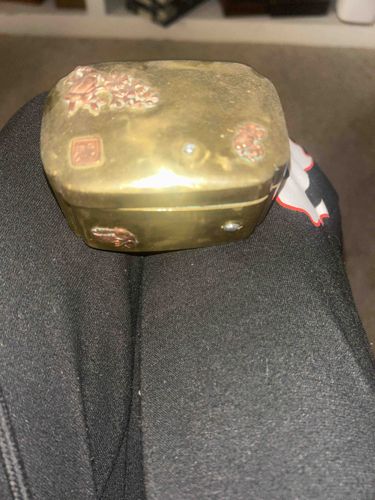
This appears to be an antique Japanese mixed metal covered box, likely dating from the Meiji period (1868-1912) due to its aesthetic and characteristic use of mixed metals. The box is predominantly crafted from a yellow brass or bronze alloy, forming a rectangular shape with gently rounded corners and convex sides. The lid fits snugly over the base, suggesting a well-made construction intended to protect its contents. The primary decorative elements are applied or embedded mixed metal motifs, primarily in a reddish-brown copper alloy, depicting what appear to be floral or botanical designs. These designs are executed in a repoussé or chiseled technique, creating a low relief that stands out against the brass background. One prominent feature is a square cartouche-like marking on the lid, containing what looks like a stylized kanji or character, possibly a maker's mark or artist's signature; however, details are indistinct due to the image resolution and condition. There are also several small, circular, silver-colored studs or rivets seemingly embedded into the brass, flanking some of the decorative elements, which could be part of the design or possibly later repairs/additions. The overall condition shows significant signs of age and wear. The brass has developed a dark, uneven patination and appears somewhat dull, with various scuffs, scratches, and possibly some surface corrosion. The relief decorations show wear and some loss of detail, indicative of handling over many years. There are no obvious major dents or breakages, but finer details are hard to ascertain. The craftsmanship, particularly the detailed mixed metal work and the seemingly tight fit of the lid, suggests a quality piece for its era, likely intended for a specific purpose such as holding incense, trinkets, or personal accessories.
AI Appraisal Report
Based on my visual examination of the provided image, this antique Japanese mixed metal covered box appears to be a genuine artifact from the Meiji period (1868-1912). The aesthetic, use of various metal alloys (brass/bronze and copper), and the repoussé/chiseled botanical motifs are consistent with decorative arts from that era. The condition exhibits significant age and wear, as expected for an item over a century old. I observe a dark, uneven patination on the brass, along with various scuffs, scratches, and apparent surface corrosion. The relief details show wear but no obvious major damage like dents or breaks. The small silver-colored studs are curious; without physical inspection, it's difficult to determine if they are original design elements or later repairs.
The market for antique Japanese mixed metal decorative boxes is generally stable but not exceptionally strong for pieces of this apparent complexity and condition. Comparable items with good provenance and in better condition, or featuring more intricate/recognizable motifs, typically command higher prices. This box's value is impacted by its relatively common form, indistinct surface details due to wear, and the unidentifiable maker's mark. Demand is moderate among collectors of Japanese decorative arts. Rarity is difficult to assess without further information, but similarly styled boxes do appear on the market.
Factors significantly impacting value include the condition, the unidentified maker's mark, and the lack of fine detail in the decoration. For full authentication and a more precise valuation, a direct physical examination is crucial. This would allow me to assess the true condition, analyze the metals, authenticate the maker's mark (if any), and determine if the silver studs are original. Provenance documentation would also be highly beneficial.