AI estimate as of June 28, 2025 · verify with a professional before acting
AI-Generated · Verify before acting
Everything on this page is generated by AI for informational purposes only. AI can make mistakes — the AI may misidentify items or misattribute them (artist, maker, brand, designer, origin, era). This is not an official valuation and should not be used for insurance, sale, tax, estate, legal, or lending purposes — or any decision requiring a certified appraisal. It is not an authoritative claim about any person, brand, or rights holder — do not share or rely on it as a factual statement about a third party. Always consult qualified professionals before making financial decisions.
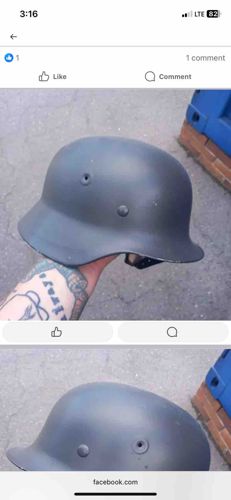
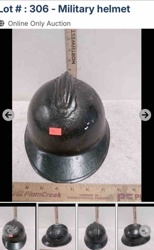
This is a German military helmet, commonly known as a Stahlhelm, likely a World War II era M40 or M42 model due to its distinctive shape and visible construction features. The helmet shell is constructed from steel, exhibiting a matte, dark grayish-green or field gray finish, characteristic of active service military headgear. Its iconic 'coal scuttle' or 'turtle shell' form includes a pronounced flared skirt extending around the base and a smoothly rounded dome. Visible on the side of the shell are two significant features: an elongated oval ventilation hole located on the upper half, and a dome-headed rivet situated further down, which typically serves to secure the internal liner band to the shell. The surface displays signs of wear consistent with age and use, including minor scuffs, dust accumulation, and subtle variations in the matte paint finish, but no obvious major dents, cracks, or structural damage are discernible from the provided image. There are no national or unit decals visible, which could indicate post-war repainting, a late-war manufacture where such decals were often omitted, or simply severe wear having completely eroded them. The craftsmanship appears utilitarian and robust, designed for military function rather than elaborate aesthetics, typical of mass-produced wartime equipment.
AI Appraisal Report
As an appraiser, I have examined the provided image of what appears to be a German Stahlhelm, likely an M40 or M42 model from the WWII era. The "coal scuttle" shape, steel construction, and field gray finish are consistent with authentic examples. The presence of the elongated ventilation hole and dome-headed rivet strongly support its period authenticity as a standard issued combat helmet shell. The surface displays expected wear, including scuffs and dust, without major dents or damage, suggesting a well-preserved shell.
However, there are no visible national or unit decals, nor is there any indication of an internal liner or chinstrap. This significantly impacts its market value. While WWII German militaria, especially Stahlhelms, enjoys consistent high demand, the absence of decals (which original helmets often had) and internal components places this piece at the lower end of the value spectrum for genuine examples. Helnets with original, intact decals, liners, and chinstraps command premium prices, often in the thousands.
Its value is primarily derived from being an authentic period shell. Demand for genuine German WWII artifacts remains strong, but this piece, being incomplete and lacking distinct markings/decals, is less rare than a fully equipped or unit-marked helmet.
Crucially, authenticity cannot be definitively guaranteed from images alone. A physical inspection would be required to verify manufacturer's stamps, lot numbers, and potential size marks on the interior skirt. Microscopic paint analysis could confirm originality and detect any signs of repainting or decal removal. The weight, metallurgy, and the presence of any ghosting where decals might have been would all be critical for full authentication. Without these in-person checks and comprehensive provenance, this appraisal is based solely on visual characteristics.