These notes were written by the person who submitted this item. Appraiser.AI has not verified them, and the AI's identification and estimate may rely on them.
AI Estimated Value
Not an official valuation
$30-75
AI estimate as of June 27, 2025 · verify with a professional before acting
AI-Generated · Verify before acting
Everything on this page is generated by AI for informational purposes only. AI can make mistakes — the AI may misidentify items or misattribute them (artist, maker, brand, designer, origin, era). This is not an official valuation and should not be used for insurance, sale, tax, estate, legal, or lending purposes — or any decision requiring a certified appraisal. It is not an authoritative claim about any person, brand, or rights holder — do not share or rely on it as a factual statement about a third party. Always consult qualified professionals before making financial decisions.
This analysis also relies on unverified notes provided by the user, which may be incomplete or inaccurate and could affect the result.
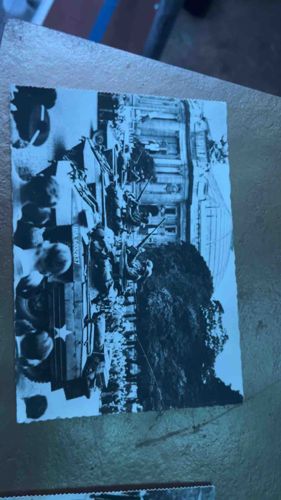
This item is a historical black and white photographic postcard, consistent with those produced during or immediately following the World War I era (circa 1914-1920s), as suggested by the provided context. The card measures what appears to be a standard postcard size, typically around 3.5 x 5.5 inches (9 x 14 cm), and is printed on photographic paper, likely an albumen or silver gelatin print. The image is a monochrome print, characterized by its range of black, white, and grey tones, with a noticeable degree of graininess common to photographic technology of the period.
The photograph itself depicts an outdoor urban scene, likely a street or public square. A prominent architectural structure, possibly a church, cathedral, or a grand public building with multiple stories and arched windows or entrances, dominates the right side of the frame. In the mid-ground, there are multiple figures, several of whom appear to be soldiers in military uniform, consistent with the WWI context. They are gathered in what seems to be a procession or a significant public event. On the left side of the foreground, a crowd of onlookers is visible, their details indistinct due to distance and the print's resolution. A large, dark, organic mass, appearing to be a tree or dense foliage, occupies the right foreground. The overall composition suggests a historical event or a scene from daily wartime life.
Visible condition issues include general surface wear, minor abrasions, and a slight darkening or smudging in the upper left corner. The resolution of the image makes it difficult to ascertain specific creases or significant damage, but typical handling wear for an item of this age is implied. The edges of the postcard appear to have a slightly uneven, possibly deckled finish, a common stylistic choice for postcards from this era. No manufacturer's marks, stamps, or specific inscriptions are discernible on the visible front side. The historical subject matter and its probable age contribute to its significance as a piece of military or archival ephemera, offering insight into the visual culture and events of World War I.
AI Appraisal Report
I have carefully examined the provided image of this World War I Era Photographic Postcard. Based on the visual evidence, the item appears to be an authentic period piece, consistent with photographic postcards produced between 1914 and the early 1920s. The photographic quality, print tones, and depicted uniforms align with period technology and subject matter. The visible condition shows general surface wear, minor abrasions, and some darkening in the upper left, which are all typical of an item of this age and use. The edges also suggest an appropriate finish for the era. However, without a physical inspection, I cannot definitively ascertain the specific photographic process (e.g., silver gelatin), the exact paper stock, or any hidden damage/repairs. Full authentication would require in-person examination, including viewing the reverse side for postmarks or inscriptions, and potentially specialized analysis like UV light examination or microscopy to verify print details and material composition.
In terms of market conditions, WWI-era photographic postcards are relatively common. Their value is highly dependent on subject matter, rarity, condition, and any specific historical significance. Generic scenes or common troop photos typically range from $5 to $30. Postcards depicting identifiable locations, specific military units, well-known events, or those with significant provenance (e.g., soldier's letters) command higher prices. This postcard, featuring soldiers in uniform during what appears to be a public event, is more interesting than a generic landscape or still life, contributing positively to its demand. Rarity, however, is difficult to assess without knowing the depicted location or event, and no specific identifying marks are visible. While there's steady demand from militaria and postcard collectors, it's not exceptionally high for unidentified pieces.
The primary factor limiting a higher appraisal value for this specific item is the lack of specific identification for the location, event, or individuals. If further research, potentially through physical examination of the reverse side or expert analysis of the imagery, could pinpoint a historically significant event, unit, or locale, the value could increase substantially. As it stands, it’s a good example of a common but appealing WWI-era photographic postcard.