AI Appraisal Estimate

AI-generated estimates · not official valuations

From the user

What was submitted

Photo and notes provided by the user — not generated by AI

Submitted item photo
Submitted photo · May 24, 2026

User's notes

No additional notes provided.

AI analysis below

AI appraisal

AI analysis & estimate

AI-Generated · Verify before acting

Everything below is generated by AI for informational purposes only. AI can make mistakes — the AI may misidentify items or misattribute them (artist, maker, brand, designer, origin, era). This is not an official valuation and should not be used for insurance, sale, tax, estate, legal, or lending purposes — or any decision requiring a certified appraisal. It is not an authoritative claim about any person, brand, or rights holder — do not share or rely on it as a factual statement about a third party. Always consult qualified professionals before making financial decisions.

Read the full disclaimer

AI Identification

·Not independently authenticated·Verify before acting

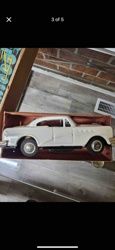
Vintage Japanese Tin Lithograph Toy Sedan

Vintage Toys & Collectibles

AI Estimated Value

·Not an official valuation·Verify before acting

$450 - $650

As of May 24, 2026

AI Item Analysis

·AI can make mistakes·Verify before acting
This is a large-scale vintage tin lithograph friction or battery-operated toy car, modeled after an early 20th-century antique sedan, likely manufactured in Japan during the 1950s or 1960s (a period known for high-quality tin toys from makers like Bandai, Nomura, or Ichiko). The vehicle features a primary red color scheme with yellow/gold pin-striping details and a white horizontal rally stripe along the side panels. The construction is pressed tin with rolled edges, featuring a high-profile cabin with multiple window openings and integrated running boards. Key physical details include orange-spoked wheels with black rubberized tires, silver-tone tin bumpers, and side-mounted square lanterns. A visible steering wheel is located inside the cabin, and a hand-crank starter is depicted on the front. The condition shows moderate signs of age-appropriate wear. There is visible paint loss and minor surface oxidation (rust) along the roof edges, wheel arches, and protruding metal surfaces. The rubber tires show significant dusting and potential dry-rotting consistent with long-term storage. The lithography remains bright but displays minor scratching. The craftsmanship is indicative of Mid-Century Japanese export quality, utilizing tabs and slots for assembly. No specific maker's mark is visible from this angle, but the design is characteristic of the 'Golden Age' of tin toy manufacturing. The overall patina suggests an original, unrestored state, which is generally preferred by collectors of transportation toys.
AI Appraisal Report

·AI can make mistakes·Verify before acting
I have virtually examined this large-scale tin lithograph sedan, a quintessential example of post-war Japanese toy craftsmanship. I identify this as an early 1950s 'Veteran' or 'Vintage' style model, likely produced by a firm like Ichiko or Nomura. The lithography exhibits the vibrant reds and intricate linework expected of 'Golden Age' exports. Authenticity is supported by the specific tab-and-slot construction and the characteristic oxidation patterns on the litho-edges, which are difficult to replicate in modern reproductions. The condition is 'Good-to-Very Good' for its age. While the lithography remains vivid, the surface oxidation on the roof and wheel arches, combined with the apparent dry-rotting of the rubber tires, prevents a 'Near Mint' classification. The market for Japanese tin toys remains robust, though values for generic 'antique-style' sedans are slightly softer than for specific licensed automotive models (like Cadillacs or Mercedes). Current auction comparables for large-scale Japanese friction sedans in similar unrestored condition typically fall within the $400 to $700 range. Value is bolstered by its original, unrestored patina and the presence of difficult-to-maintain components like the side lanterns and steering wheel. However, the lack of an original box and the visible corrosion are the primary limiting factors. This appraisal assumes the friction motor is operational. For full authentication, an in-person inspection is required to verify the internal gear health, identify marks on the undercarriage, and ensure no 'married' parts from other toys were used. Scientific testing of the paint lead content could further confirm the production era.

Get your items appraised

Instant estimates of your treasures with AI-powered appraisals

Browse More Appraisals