AI estimate as of December 3, 2025 · verify with a professional before acting
AI-Generated · Verify before acting
Everything on this page is generated by AI for informational purposes only. AI can make mistakes — the AI may misidentify items or misattribute them (artist, maker, brand, designer, origin, era). This is not an official valuation and should not be used for insurance, sale, tax, estate, legal, or lending purposes — or any decision requiring a certified appraisal. It is not an authoritative claim about any person, brand, or rights holder — do not share or rely on it as a factual statement about a third party. Always consult qualified professionals before making financial decisions.
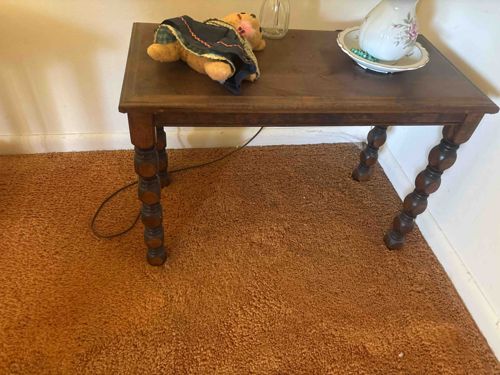
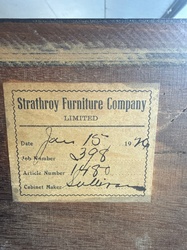
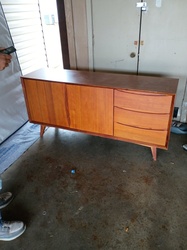
This is a small, rectangular side table crafted from wood, likely a darker species such as walnut or mahogany, or possibly a stained lighter wood to achieve its rich brown hue. The tabletop features a slightly beveled or rounded edge, suggesting some attention to detail in its construction. The surface of the tabletop displays a visible grain pattern, indicating solid wood construction rather than veneer, though closer inspection would confirm this. There are minor scuffs and scratches on the tabletop, consistent with regular use and age, contributing to a natural patina. The most distinctive features are the four legs, which are intricately turned with a 'bobbin' or 'spool' design, characterized by a series of repeating rounded or spherical elements stacked vertically. This turning style is often associated with early American or Colonial Revival furniture. The legs appear sturdy and are joined to the tabletop with a simple apron, which is visible just below the top surface. There are no obvious signs of major damage or repairs from the visible angles, though the overall finish shows some wear. The table's design suggests a style period from the late 19th to mid-20th century, leaning towards a traditional or rustic aesthetic. The craftsmanship appears competent for a utilitarian piece, focusing on the decorative turning of the legs. No manufacturer's marks or signatures are discernible in the provided image. The dimensions appear to be suitable for an end table or occasional table, approximately 2-3 feet in length and 1.5-2 feet in width.
AI Appraisal Report
I have virtually examined this Turned Leg Side Table based on the provided image and description. The table presents as a small, rectangular piece, likely crafted from a dark wood or stained. The visible grain pattern suggests solid wood construction, which is a positive attribute, though only an in-person inspection could confirm this definitively over a veneer. The overall condition shows minor scuffs and scratches on the tabletop, consistent with regular use and age, contributing to a natural patina rather than detracting significantly from its aesthetic. There are no obvious signs of major damage or repairs from the visible angles, which is good. The most distinctive feature is undoubtedly the four bobbin-turned legs, a style often associated with early American or Colonial Revival aesthetics, placing its likely origin from the late 19th to mid-20th century. The craftsmanship appears competent for a utilitarian piece.
In terms of market conditions, similar turned-leg side tables from this period, without significant provenance or attribution to a notable maker, generally fall into a modest price range. There is a steady, but not high-demand market for such traditional, functional pieces. Rarity is not a significant factor here; bobbin-turned furniture was fairly common during its peak popularity. Factors impacting value positively are the solid wood appearance and the intact nature of the turned legs. Negatively, the lack of maker's marks, scuffs on the top, and its relatively common design limit its upper value potential. Higher values would typically require exceptional wood quality, a known maker, or impeccable condition.
Limitations in authenticity verification from images alone are significant. I cannot definitively confirm the wood species, whether it's solid wood throughout, the structural integrity of the joints, or the exact age. For full authentication and a more precise valuation, an in-person examination would be needed to assess the wood type, construction methods, and any hidden damage or repairs. Provenance documentation would be invaluable to confirm its age and origin.