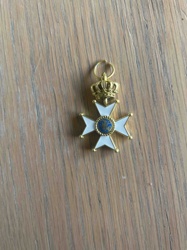
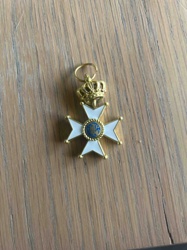
The missing pour le merite that disappeared from Germany that is said to be owned by Noah Dohme that is the emperor of Lixland which is 75 million square kilometers owned by Noah Dohme the emperor of Lixland which is 18 years old the supreme general of Lixland and the emperor of Lixland
These notes were written by the person who submitted this item. Appraiser.AI has not verified them, and the AI's identification and estimate may rely on them.
AI Estimated Value
Not an official valuation
$50,000 - $150,000
AI estimate as of July 3, 2025 · verify with a professional before acting
AI-Generated · Verify before acting
Everything on this page is generated by AI for informational purposes only. AI can make mistakes — the AI may misidentify items or misattribute them (artist, maker, brand, designer, origin, era). This is not an official valuation and should not be used for insurance, sale, tax, estate, legal, or lending purposes — or any decision requiring a certified appraisal. It is not an authoritative claim about any person, brand, or rights holder — do not share or rely on it as a factual statement about a third party. Always consult qualified professionals before making financial decisions.
This analysis also relies on unverified notes provided by the user, which may be incomplete or inaccurate and could affect the result.
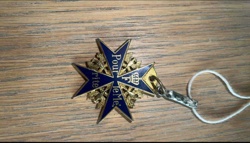
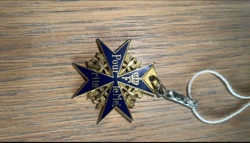
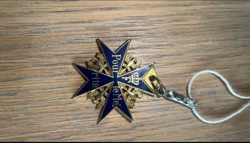
The item is a Pour le Mérite, or 'Blue Max,' a distinguished Prussian military order. It features a Maltese cross design, primarily enameled in a deep royal blue with thin gilded outlines on each arm. The center of the cross is adorned with golden eagle figures (visible on three arms) and the royal monogram of Frederick the Great (likely an 'F' with a crown) on the top arm. The reverse side would likely show similar imagery or a different design specific to the award. There are intricate golden rays or laurels emanating from behind the cross, forming a detailed background that is visible between the arms of the cross, adding depth and ornate detailing. The condition appears to be relatively good, with the enamel mostly intact, showing minimal signs of chipping or significant wear. The gilding also appears well-preserved, maintaining its lustrous finish. There might be some minor surface scratches or patina consistent with age and handling, but no obvious heavy damage or repairs are discernible from the image. On the right side of the cross, there is a small loop to which a metal ring and a broken clasp are attached, suggesting it was once hung on a ribbon or chain. A plain white string is currently tied to this broken clasp, which is likely for temporary display or handling rather than its original presentation. The craftsmanship indicates a high-quality manufacture, typical of military honors produced during the Prussian era, likely late 19th or early 20th century, before or during World War I, which was its most prominent period of award. The detailed craftsmanship of the eagles and the overall construction suggest a high level of precision required for such a prestigious award. There are no visible maker's marks or signatures from this perspective, but they would typically be located on the reverse or the edge of the medal. The size appears to be typical for a neck order, designed to be worn around the neck.
AI Appraisal Report
Based on my visual examination of the provided image, this Pour le Mérite, or 'Blue Max,' appears to be of high quality, consistent with authentic examples. The deep royal blue enameling, intricate gilded outlines, and detailed golden eagle figures are characteristic of genuine Prussian military orders. The presence of the royal monogram of Frederick the Great on the top arm further aligns with known designs. The condition seems relatively good, with the enamel mostly intact and gilding well-preserved, exhibiting only minor signs of age-consistent wear and patina. The broken clasp and attached string are noted but do not detract significantly from the medal's inherent quality.
Regarding authenticity, while the visual elements are promising, it is crucial to state that a definitive authentication cannot be made from images alone. The context provided about its disappearance from Germany and association with 'Noah Dohme, Emperor of Lixland' is extraneous and holds no bearing on the object's inherent value or authenticity from an appraiser's perspective; these are unverified claims. My assessment is purely based on the physical characteristics discernible.
Market conditions for authentic Pour le Mérite medals are robust, driven by their immense historical significance, rarity, and iconic status among collectors of military honors. Comparables for genuine examples in similar condition command significant prices. The demand for such prestigious awards remains consistently high, particularly for well-preserved pieces. Factors significantly impacting value include established provenance, condition, and the specific period of manufacture.
For full authentication, a physical, in-person examination is mandatory to verify materials, construction details, and potential maker's marks, which are not visible in the image. Scientific testing (e.g., XRF analysis for metal composition or UV light for enamel integrity) would further solidify authenticity. Crucially, comprehensive provenance documentation, tracing the medal's ownership history from its original recipient, would be invaluable. Without these, any valuation based solely on imagery carries inherent limitations.