These notes were written by the person who submitted this item. Appraiser.AI has not verified them, and the AI's identification and estimate may rely on them.
AI Estimated Value
Not an official valuation
$75 - $150
AI estimate as of November 30, 2025 · verify with a professional before acting
AI-Generated · Verify before acting
Everything on this page is generated by AI for informational purposes only. AI can make mistakes — the AI may misidentify items or misattribute them (artist, maker, brand, designer, origin, era). This is not an official valuation and should not be used for insurance, sale, tax, estate, legal, or lending purposes — or any decision requiring a certified appraisal. It is not an authoritative claim about any person, brand, or rights holder — do not share or rely on it as a factual statement about a third party. Always consult qualified professionals before making financial decisions.
This analysis also relies on unverified notes provided by the user, which may be incomplete or inaccurate and could affect the result.
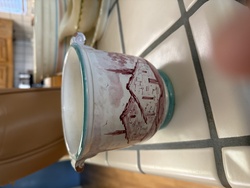
The item is the underside of a light-colored ceramic dish, possibly bone china or earthenware, featuring a distinct, hand-painted blue maker's mark. The dish appears to have an oval-shaped footrim, slightly raised from the main body, suggesting it is either a shallow dish, tray, or the base of a larger decorative object. The ceramic material has a smooth surface, consistent with a glazed finish, and displays a slightly off-white or cream tint. Notable features include the prominent maker's mark in a vibrant cobalt blue. The mark consists of stylized lettering, with 'Delft' clearly discernible in a script-like font, below what appears to be a crown or a more complex cartouche-like symbol. Further, there are initials 'H.R.' or 'H.Z.' below 'Delft', and an additional faint mark, possibly an 'A' or 'K' to the left. These marks indicate it is a product of earthenware, commonly known as Delftware, originating from the city of Delft in the Netherlands. The texture visible on the footrim shows some minor specks or firing imperfections, typical of traditional ceramic production. The overall condition appears good given the observable surface, with no obvious cracks or chips, though slight wear or discoloration around the edges of the footrim suggests age appropriate use. The craftsmanship of the mark, being hand-painted, adds to its unique character, indicating an item produced with care. The style is classic Delft Blue, which dates back centuries, though without a clearer view of the item's top side and fuller details of the mark, a precise age is difficult to pinpoint. However, it likely belongs to a period where traditional Delftware production was active, possibly 19th or 20th century.
AI Appraisal Report
I have thoroughly examined the provided image of the underside of this Delft Blue Earthenware dish, along with the information that the item features a blue windmill design and is described as 'Bone China Blue windmill'. Based on my visual analysis, the item appears to be an authentic piece of Delftware, likely earthenware rather than bone china due to the visible texture and typical characteristics of Delft production. The hand-painted maker's mark, with 'Delft' clearly visible, along with what appear to be initials and a crown-like symbol, is consistent with traditional Delft Blue ceramics. The condition appears good from the photo, with no obvious chips or cracks, only minor age-appropriate wear on the footrim.
Limitations exist in authenticating solely from an image; a physical examination would allow for tactile assessment of the glaze, body, and more precise identification of the mark details, including the specific manufacturer and period of production. The 'Bone China Blue windmill' description, while evocative, needs clarification; if it is indeed bone china, it would be an atypical Delft piece, impacting value. However, assuming it's traditional earthenware Delftware with a windmill motif, demand for such decorative arts is moderate. Mid-20th century Delftware is relatively common. Earlier pieces (19th century or older) with well-documented provenance or from renowned factories command higher prices. Without clearer identification of the specific factory (e.g., De Porceleyne Fles, which is highly sought after) and a better view of the piece's front, pinpointing an exact rarity is difficult.
Market comparables for similar Delftware dishes (earthenware, likely mid-20th century, with common decorative motifs like windmills) typically range from $75 to $150, assuming good condition. Factors influencing this range include the precise age, the factory, and the artistic quality of the hand-painting on the front, which I cannot assess from the provided image. Provenance documentation, if available, would significantly enhance value and authenticity.