AI Appraisal Estimate

AI-generated estimates · not official valuations

From the user

What was submitted

Photo and notes provided by the user — not generated by AI

Submitted item photo
Submitted photo · June 20, 2026

User's notes

No additional notes provided.

AI analysis below

AI appraisal

AI analysis & estimate

AI-Generated · Verify before acting

Everything below is generated by AI for informational purposes only. AI can make mistakes — the AI may misidentify items or misattribute them (artist, maker, brand, designer, origin, era). This is not an official valuation and should not be used for insurance, sale, tax, estate, legal, or lending purposes — or any decision requiring a certified appraisal. It is not an authoritative claim about any person, brand, or rights holder — do not share or rely on it as a factual statement about a third party. Always consult qualified professionals before making financial decisions.

Read the full disclaimer

AI Identification

·Not independently authenticated·Verify before acting

Needle-Etched Crystal Cordial or Liqueur Glass

Vintage Glassware / Stemware

AI Estimated Value

·Not an official valuation·Verify before acting

$15.00 - $25.00

As of June 20, 2026

AI Item Analysis

·AI can make mistakes·Verify before acting
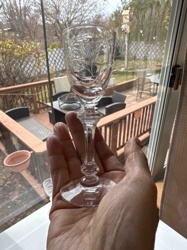
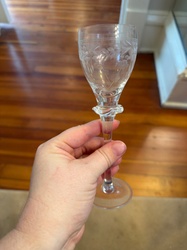
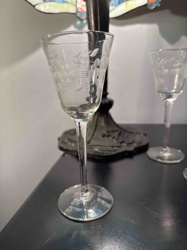
This is a fine-walled cordial or liqueur glass featuring a distinct needle-etched pattern. The glass is composed of clear, colorless crystal with a rounded, bowl-shaped receptacle, a long, slender cylindrical stem, and a flat circular foot. The bowl is decorated with a delicate and intricate etched design, likely produced via a needle-etching process common in the early to mid-20th century. The motif appears to be a series of looping scrolls and possible floral elements encircling the upper two-thirds of the bowl. The construction suggests a three-piece mold or blown glass method, showing high-quality craftsmanship characterized by the thinness of the bowl's rim and the clarity of the material. There are no immediate maker's marks visible in the image, though this style is consistent with mid-century patterns from manufacturers like Fostoria, Cambridge, or Tiffin. The condition appears to be excellent with no visible chips, cracks, or clouding; the glass retains a high degree of transparency and luster. Based on the aesthetic and etching technique, this piece likely dates from the 1930s to the 1950s. The long, elegant stem indicates it was designed for formal service of spirits or dessert wines.
AI Appraisal Report

·AI can make mistakes·Verify before acting
Based on my visual examination of the provided documentation, I have assessed this needle-etched cordial glass. The piece exhibits characteristic traits of American Depression-era or mid-century elegant glass, specifically the delicate 'needle-etching' popularized by firms such as Fostoria, Cambridge, or Tiffin between 1930 and 1950. The clarity of the crystal and the refined, thin-walled construction suggest a high-quality manufacture. The condition appears excellent with no visible 'sickness' (cloudiness), flea bites, or rim chips, which are the primary detractors for crystal of this age. The market for individual stemware pieces, particularly small-capacity vessels like cordials, is currently driven by replacement buyers rather than large-scale collectors. While the craftsmanship is superior to modern mass-produced glass, the abundance of such patterns in the secondary market keeps prices accessible. Comparable sales for unidentified or common needle-etch patterns typically fall within the $15-$25 range per stem. Authenticating the specific maker (e.g., Tiffin’s 'June' or Fostoria’s 'Navarre' variations) would require cross-referencing factory catalog line drawings against the exact scroll count of the etching. Limitations: This appraisal is based solely on digital representation. A definitive valuation and authentication would require an in-person inspection to verify the 'ring' of the lead content, check for microscopic scratches on the base consistent with age, and identify any 'straw marks' or bubbles that indicate production era. Provenance documentation or original boxed sets would enhance the certainty of the origin. Without a physical signature or acid stamp, which were often absent on this type of stemware, attribution remains stylistic rather than absolute.

Get your items appraised

Instant estimates of your treasures with AI-powered appraisals

Browse More Appraisals