AI Appraisal Estimate

AI-generated estimates · not official valuations

From the user

What was submitted

Photo and notes provided by the user — not generated by AI

Submitted item photo
Submitted photo · June 18, 2026

User's notes

Firenze

AI analysis below

AI appraisal

AI analysis & estimate

AI-Generated · Verify before acting

Everything below is generated by AI for informational purposes only. AI can make mistakes — the AI may misidentify items or misattribute them (artist, maker, brand, designer, origin, era). This is not an official valuation and should not be used for insurance, sale, tax, estate, legal, or lending purposes — or any decision requiring a certified appraisal. It is not an authoritative claim about any person, brand, or rights holder — do not share or rely on it as a factual statement about a third party. Always consult qualified professionals before making financial decisions.

Note

This analysis also relies on unverified notes provided by the user, which may be incomplete or inaccurate and could affect the result.

Read the full disclaimer

AI Identification

·Not independently authenticated·Verify before acting

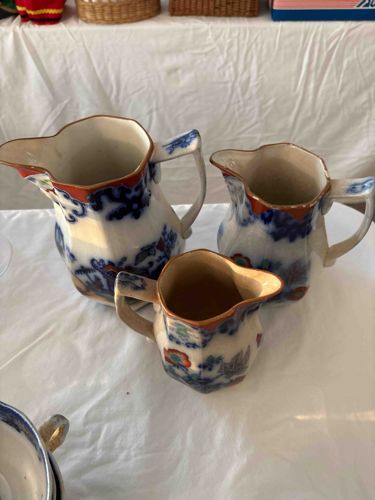
Trio of Mason’s Ironstone Hydra Jugs in Imari Style

Antique Ceramics and Pottery

AI Estimated Value

·Not an official valuation·Verify before acting

$450 - $650

As of June 18, 2026

AI Item Analysis

·AI can make mistakes·Verify before acting
This set consists of three graduated hydra-headed jugs, commonly associated with Mason’s Ironstone or similar Staffordshire potteries. Each vessel features an octagonal, faceted body crafted from heavy ironstone ceramic, characterized by its off-white or creamy base glaze. The decoration is executed in a traditional Imari-inspired palette, utilizing deep cobalt blue flow glazes, bright iron-red (rust) accents, and touches of green and gold. The larger two jugs exhibit the classic 'snake' or hydra-shaped handles with molded detailing. The patterns depict stylized floral landscapes and scrollwork typical of the mid-19th century Victorian era. Notable features include wide, pinched pouring spouts and a robust, utilitarian construction. Regarding condition, there is visible wear to the gilding on the rims and handles, consistent with age. Subtle crazing is present across the glaze, and the smallest jug shows significant loss of the handle's luster. No major cracks are immediately apparent, though some minor chips may exist along the foot rims. These pieces represent the high-quality, durable earthenware popular in English households between 1830 and 1860, showcasing a fusion of Eastern aesthetics and Western industrial craftsmanship.
AI Appraisal Report

·AI can make mistakes·Verify before acting
I have examined the descriptions and images of this graduated trio of Mason’s Patent Ironstone Hydra jugs. These pieces are quintessential examples of mid-Victorian English earthenware, dating between 1830 and 1860. The octagonal form and 'Hydra' (serpent) handles are hallmark designs of the Mason's factory, though several Staffordshire competitors produced similar models. The Imari-style palette—utilizing cobalt blue, iron red, and gilt—remains a highly collectible aesthetic that blends Eastern inspiration with Western industrial durability. In my assessment, the condition is consistent with 'fair to good' for domestic antiques of this age. The notable gilt loss on the rims and the luster degradation on the smallest jug’s handle suggest heavy use, which slightly tempers the valuation. However, the presence of a complete graduated set of three adds a premium over individual pieces. The market for mid-range ironstone remains stable, though buyers currently favor pieces with intact gilding and minimal crazing. For a definitive authentication, I would require an in-person inspection to verify the presence of the 'Mason’s Patent Ironstone' crown stamp on the underside, as well as a blacklight examination to ensure no professional repairs (spraying or filling) have been made to the spouts or handles. The absence of major structural cracks or 'killed' gilding preserves their functional and decorative appeal. This appraisal assumes the pieces are authentic period examples and not later 20th-century reproductions.

Get your items appraised

Instant estimates of your treasures with AI-powered appraisals

Browse More Appraisals