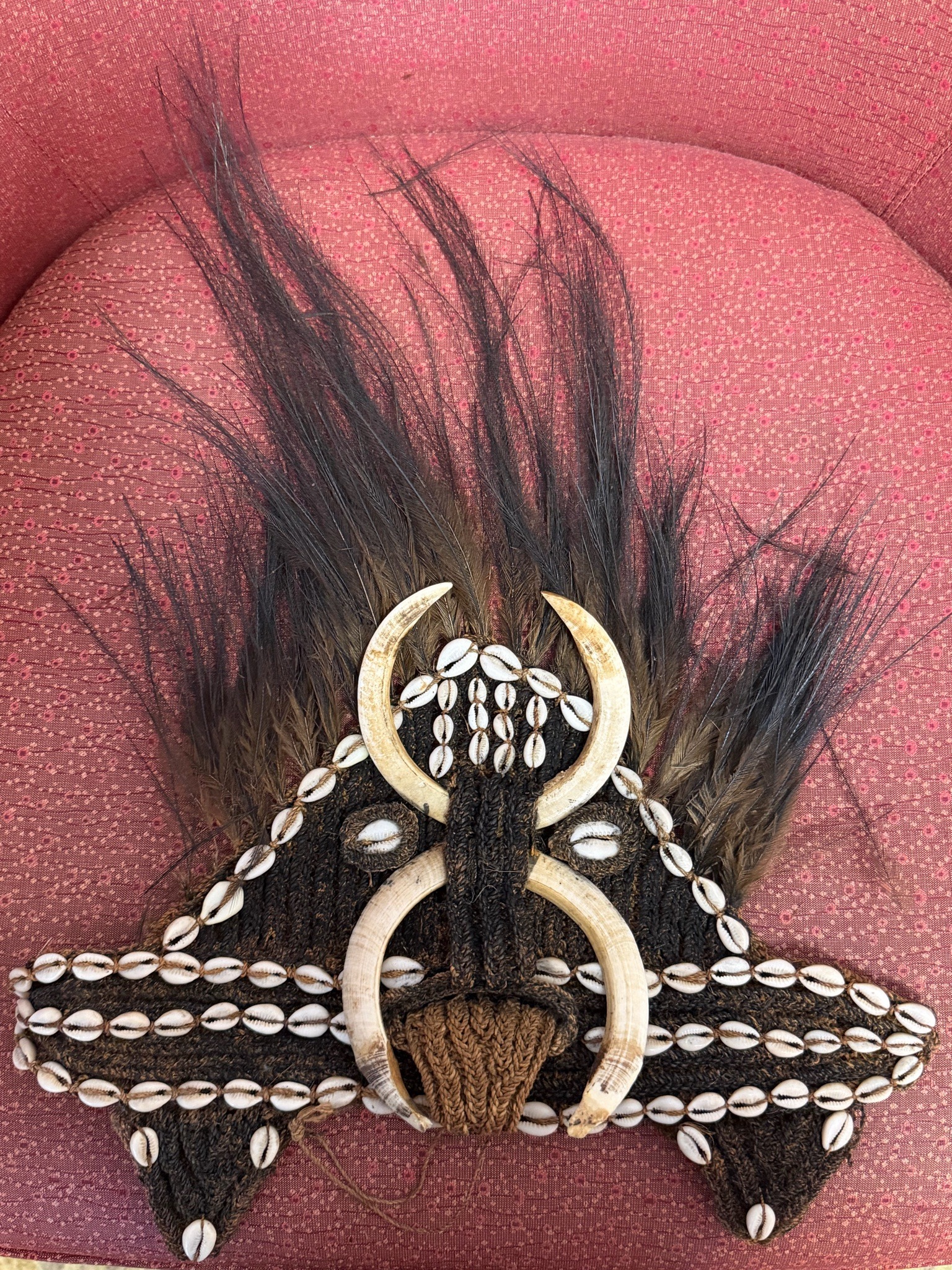
Papua New Guinea Highlands Boar Tusk and Cowrie Shell Headdress
Tribal Art and Ethnographic Artifacts

Papua New Guinea Highlands Boar Tusk and Cowrie Shell Headdress

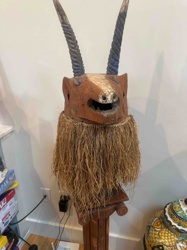
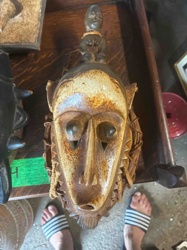
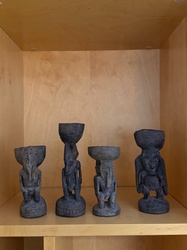
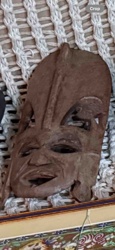
This is a ceremonial headdress, likely originating from the Highlands region of Papua New Guinea. It is constructed on a hand-woven natural fiber base in dark earth tones, featuring intricate knotting and crochet-like textures. The central focal points are two pairs of large, cured pig tusks (boar tusks) arranged in circular pairs. The piece is heavily embellished with Nassa or Cowrie shells, meticulously stitched onto the fiber base in geometric patterns and linear borders. Rising from the top are numerous long, dark cassowary feathers mixed with brownish plumage, creating a fan-like spray. The craftsmanship suggests traditional indigenous techniques where materials like bone, shell, and feathers serve as indicators of status and wealth. Assessing the condition, the tusks show natural yellowing and some minor stress fractures consistent with age and biological origin. Some shells exhibit slight chipping, and the woven fiber appears stable but shows some typical fraying and loose threads at the lower perimeter. This style of regalia is common among several Highland groups, used during 'sing-sings' or exchange ceremonies, and likely dates from the mid-to-late 20th century.

Estimated Value

$1,200 - $1,800 USD

Basic Information

Category

Tribal Art and Ethnographic Artifacts

Appraised On

May 6, 2026

Estimated Value

$1,200 - $1,800 USD

Item Description

This is a ceremonial headdress, likely originating from the Highlands region of Papua New Guinea. It is constructed on a hand-woven natural fiber base in dark earth tones, featuring intricate knotting and crochet-like textures. The central focal points are two pairs of large, cured pig tusks (boar tusks) arranged in circular pairs. The piece is heavily embellished with Nassa or Cowrie shells, meticulously stitched onto the fiber base in geometric patterns and linear borders. Rising from the top are numerous long, dark cassowary feathers mixed with brownish plumage, creating a fan-like spray. The craftsmanship suggests traditional indigenous techniques where materials like bone, shell, and feathers serve as indicators of status and wealth. Assessing the condition, the tusks show natural yellowing and some minor stress fractures consistent with age and biological origin. Some shells exhibit slight chipping, and the woven fiber appears stable but shows some typical fraying and loose threads at the lower perimeter. This style of regalia is common among several Highland groups, used during 'sing-sings' or exchange ceremonies, and likely dates from the mid-to-late 20th century.

Get Your Items Appraised

Instant estimates of your treasures with AI-powered instant appraisals

Browse More Appraisals