AI estimate as of November 18, 2025 · verify with a professional before acting
AI-Generated · Verify before acting
Everything on this page is generated by AI for informational purposes only. AI can make mistakes — the AI may misidentify items or misattribute them (artist, maker, brand, designer, origin, era). This is not an official valuation and should not be used for insurance, sale, tax, estate, legal, or lending purposes — or any decision requiring a certified appraisal. It is not an authoritative claim about any person, brand, or rights holder — do not share or rely on it as a factual statement about a third party. Always consult qualified professionals before making financial decisions.
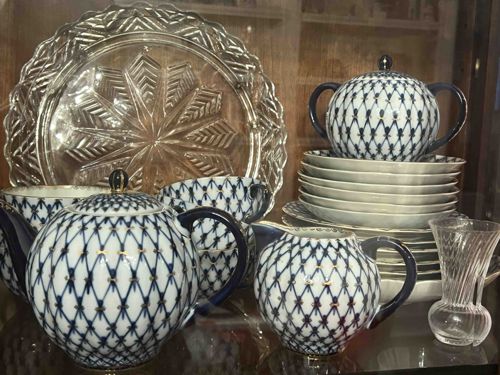
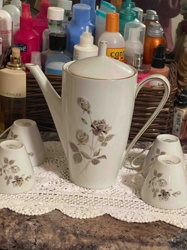
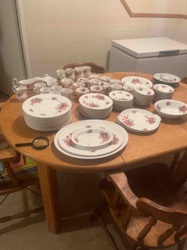
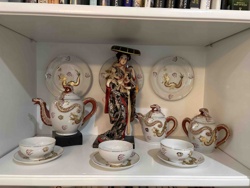
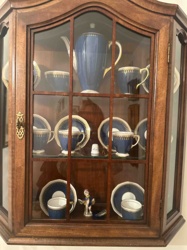
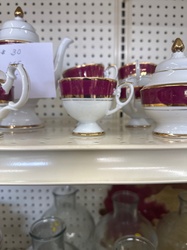
The image displays a collection of porcelain items characterized by the distinctive 'Cobalt Net' pattern, famously associated with the Lomonosov (now Imperial) Porcelain Factory of Russia. The set comprises multiple pieces, including a large teapot, a sugar bowl with a lid, a creamer or milk pitcher, several teacups, and a stack of dinner or dessert plates. The primary physical characteristic is the brilliant white porcelain base adorned with a meticulously hand-painted cobalt blue net pattern, accentuated with 22-karat gold detailing at the intersections and along the rims and handles. The teapot and sugar bowl feature spherical bodies with elegantly curved handles and lids topped with small, dark finials, possibly also gilded. The creamer shares the same globular body and an integrated handle. The teacups appear to be of a standard size, showcasing the same Cobalt Net design. The dinnerware plates are round, with a subtle rim, and a cleaner, less adorned surface, likely to allow the cobalt net pattern on the accompanying pieces to stand out. The craftsmanship is evident in the intricate and uniform application of the Cobalt Net design, which requires a delicate hand and precision. The style is classic and ornate, indicative of a mid-20th century to contemporary production, maintaining traditional Russian porcelain artistry. No significant condition issues like chips, cracks, or extensive wear are immediately visible on the porcelain items; the gold accents appear largely intact, suggesting good preservation. Alongside the porcelain, there is a large clear glass platter with a deeply cut geometric starburst pattern in the center and a scalloped, relief-decorated rim, as well as a small, fluted clear glass vase. These ancillary items suggest a complete display setting rather than being part of the porcelain tea set itself.
AI Appraisal Report
I have virtually examined this Lomonosov Imperial Porcelain 'Cobalt Net' tea set and dinnerware based on the provided image. The collection appears to be in excellent condition, with no visible chips, cracks, or significant wear to the gilding, which is a key factor in valuing porcelain sets. The 'Cobalt Net' pattern is signature to the Lomonosov (now Imperial) Porcelain Factory, characterized by its intricate hand-painted cobalt blue net design with 22-karat gold accents. From the image, the application of the pattern appears consistent and precise, indicative of authentic Lomonosov craftsmanship. The set includes a large teapot, sugar bowl, creamer, several teacups, and dinner/dessert plates, forming a substantial service.
Market conditions for Lomonosov 'Cobalt Net' are generally stable, with consistent demand for well-preserved sets. These pieces are not particularly rare, as Lomonosov produced them in large quantities, but complete sets in excellent condition like this one do command premium prices. Individual pieces often sell for less than their proportional value within a set. The overall aesthetic and condition suggest a manufactured date from the mid-to-late 20th century or more contemporary production.
While the visual evidence strongly suggests authenticity and excellent condition, a definitive appraisal is limited without a physical inspection. An in-person examination would allow me to check for any hairline cracks, manufacturer's marks, and the quality of the porcelain paste and glazes up close, which are crucial for full authentication and condition assessment. Provenance documentation, such as original purchase receipts or certificates, would further enhance certainty. Without these, the appraisal remains based on visual cues from the image alone.