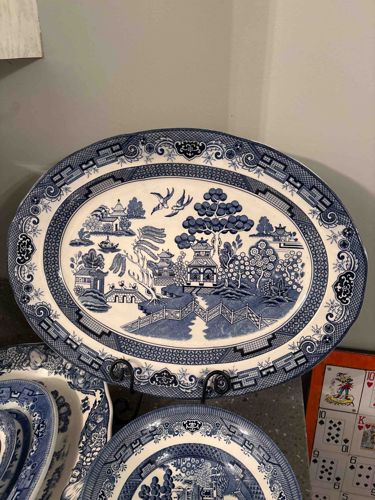
Blue Willow Pattern Oval Serving Platter
Antique and Vintage Ceramics

Blue Willow Pattern Oval Serving Platter

This is a classic oval serving platter featuring the iconic 'Blue Willow' transferware pattern. Made of white ceramics (likely ironstone or vitreous china), it showcases a detailed cobalt blue underglaze design on a bright white background. The central scene includes all the traditional motifs: two birds flying in the center, a weeping willow tree, three figures on a humpback bridge, a Chinese pagoda, and a zigzag fence. The rim is decorated with a complex geometric and scrollwork border typical of this pattern. Regarding condition, the glaze appears glossy with some light surface wear consistent with age and use. There are no visible major cracks or chips from this angle, though minor factory imperfections like transfer slips are common in this style. This specific version, given the crispness of the transfer and the slight scalloping of the edge, likely dates to the mid-to-late 20th century. While the pattern originated in the late 18th century, it has been mass-produced by numerous English and Japanese potteries, including names like Johnson Brothers, Churchill, and Spode. The craftsmanship shows a high-quality application of nineteenth-century aesthetics adapted for modern durability.
Estimated Value

$45.00 - $75.00

Basic Information

Category

Antique and Vintage Ceramics

Appraised On

February 4, 2026

Estimated Value

$45.00 - $75.00

Item Description

This is a classic oval serving platter featuring the iconic 'Blue Willow' transferware pattern. Made of white ceramics (likely ironstone or vitreous china), it showcases a detailed cobalt blue underglaze design on a bright white background. The central scene includes all the traditional motifs: two birds flying in the center, a weeping willow tree, three figures on a humpback bridge, a Chinese pagoda, and a zigzag fence. The rim is decorated with a complex geometric and scrollwork border typical of this pattern. Regarding condition, the glaze appears glossy with some light surface wear consistent with age and use. There are no visible major cracks or chips from this angle, though minor factory imperfections like transfer slips are common in this style. This specific version, given the crispness of the transfer and the slight scalloping of the edge, likely dates to the mid-to-late 20th century. While the pattern originated in the late 18th century, it has been mass-produced by numerous English and Japanese potteries, including names like Johnson Brothers, Churchill, and Spode. The craftsmanship shows a high-quality application of nineteenth-century aesthetics adapted for modern durability.
Get Your Items Appraised

Instant estimates of your treasures with AI-powered instant appraisals

Browse More Appraisals