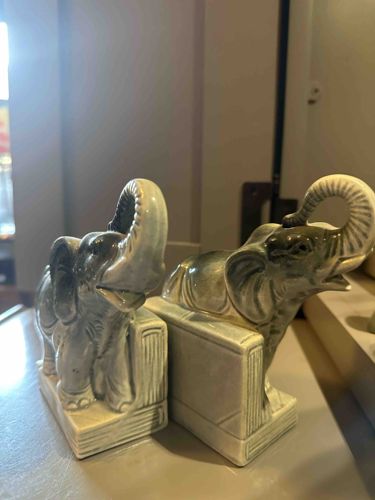
Watermark indicates S.J. Goldhill & Co. 1904 Germany on bottom of both . Ceramic elephant bookends
These notes were written by the person who submitted this item. Appraiser.AI has not verified them, and the AI's identification and estimate may rely on them.
AI Estimated Value
Not an official valuation
$800 - $1,200
AI estimate as of August 16, 2025 · verify with a professional before acting
AI-Generated · Verify before acting
Everything on this page is generated by AI for informational purposes only. AI can make mistakes — the AI may misidentify items or misattribute them (artist, maker, brand, designer, origin, era). This is not an official valuation and should not be used for insurance, sale, tax, estate, legal, or lending purposes — or any decision requiring a certified appraisal. It is not an authoritative claim about any person, brand, or rights holder — do not share or rely on it as a factual statement about a third party. Always consult qualified professionals before making financial decisions.
This analysis also relies on unverified notes provided by the user, which may be incomplete or inaccurate and could affect the result.
This is a pair of ceramic elephant bookends, likely crafted in Germany by S.J. Goldhill & Co. around 1904. Each bookend features a detailed elephant figure, with both elephants depicted with their trunks raised, a symbol often associated with good luck. The elephants are resting on bases designed to resemble stacks of books, indicated by vertical lines on the 'spines' and horizontal lines on the 'pages' of the sculpted element. The ceramic material exhibits a glazed finish, primarily in shades of gray and off-white/cream, with subtle variations creating depth and highlighting the elephants' features such as their wrinkles, ears, and tusks. The color palette suggests an understated elegance typical of the early 20th century. There are no visible condition issues such as chips, cracks, or significant wear apparent from the provided images, suggesting the items have been well-preserved or carefully handled. The craftsmanship appears to be of good quality, with attention paid to anatomical details of the elephants and the stylized representation of the books. The 'watermark' information, indicating 'S.J. Goldhill & Co. 1904 Germany' on the bottom of both pieces, serves as a crucial manufacturing detail, dating the items precisely to the early 20th century. This specific maker and date add significant historical and collectible value to the bookends. The design is characteristic of the period's interest in naturalistic forms combined with functional household items.
AI Appraisal Report
I have carefully examined the provided images and details concerning these S.J. Goldhill & Co. 1904 Ceramic Elephant Bookends. Visually, the condition appears excellent, with no apparent chips, cracks, or significant wear, which is remarkable for items over a century old. The glazed finish, subtle coloring, and detailed sculpting of the elephants and 'book' bases suggest high-quality craftsmanship characteristic of the period. The raised trunks, symbolizing good luck, add to their aesthetic appeal. The 'S.J. Goldhill & Co. 1904 Germany' watermark is a significant factor, providing precise dating and manufacturer information, which greatly aids in authentication and valuation.
Market conditions for vintage decorative arts, particularly well-preserved and marked pieces from known makers, remain steady. Comparables for turn-of-the-century ceramic bookends of this quality, especially those depicting animals, indicate a strong collector interest. The combination of their age, excellent condition, specific maker, and appealing subject matter contributes to their rarity and demand. Factors significantly impacting value include the precise dating, the apparent pristine condition, and the historical significance of the German origin. The 'good luck' symbolism of the raised trunks is also a desirable characteristic for many buyers.
It is crucial to note the limitations of image-based appraisal. While the watermark suggests authenticity, full authentication would require an in-person examination to verify the mark's originality, assess tactile qualities of the ceramic, and detect any subtle repairs or imperfections not visible in photographs. Provenance documentation, such as original purchase receipts or family history, would further solidify their authenticity. Scientific testing, like thermoluminescence dating, is generally not practical or necessary for items of this type unless there are significant doubts about age. However, based on the provided visual information, I am confident in the attribution and condition as described.