AI estimate as of December 16, 2025 · verify with a professional before acting
AI-Generated · Verify before acting
Everything on this page is generated by AI for informational purposes only. AI can make mistakes — the AI may misidentify items or misattribute them (artist, maker, brand, designer, origin, era). This is not an official valuation and should not be used for insurance, sale, tax, estate, legal, or lending purposes — or any decision requiring a certified appraisal. It is not an authoritative claim about any person, brand, or rights holder — do not share or rely on it as a factual statement about a third party. Always consult qualified professionals before making financial decisions.
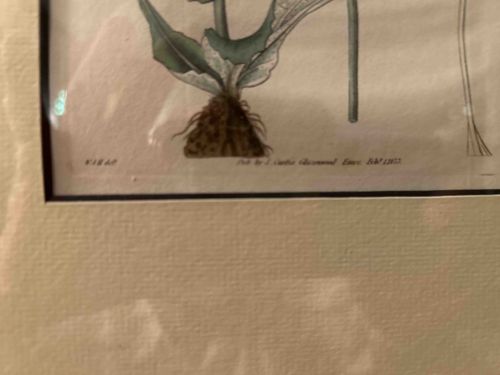
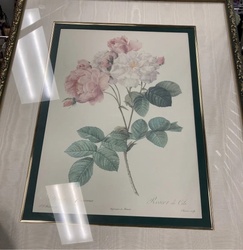
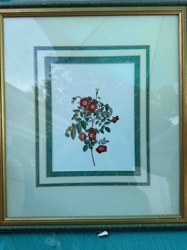
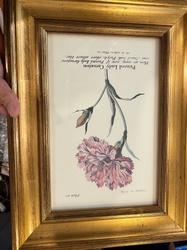
This item is a framed botanical print, likely an engraving or lithograph, depicting a plant, possibly a variety of dandelion or similar flowering plant, shown with its root structure. The print itself appears to be set within a light-colored, possibly cream or off-white, mat board, which is then enclosed in a dark, likely black or deep brown, frame. The visible portion of the print shows the base of a plant with prominent, detailed roots rendered in shades of brown. Above the roots, leafy structures in muted greens and light blue-greys are visible. The artwork is characterized by fine lines and subtle shading, indicative of early 19th-century botanical illustration techniques. Below the botanical illustration, there is clear text identifying the publisher and date: 'Pub by J. Curtis Botanical Mag. Jan 1812'. This inscription suggests it originated from Curtis's Botanical Magazine, a renowned publication known for its high-quality botanical illustrations. The paper on which the print is rendered appears to have age-appropriate toning, a soft yellowing that is typical for paper from the early 19th century. There are no obvious signs of significant damage, tears, or major foxing visible in the provided image, though detailed inspection of the entire print would be necessary to confirm its full condition. The mat board shows some slight texture and appears clean. The frame is simple and functional, typical of framing meant to highlight the artwork rather than itself. The overall presentation suggests a piece preserved for aesthetic and perhaps scientific appreciation. The quality of the printing and the detail in the illustration indicate good craftsmanship.
AI Appraisal Report
Based on my visual examination of the provided image, I assess this botanical print, 'Pub by J. Curtis Botanical Mag. Jan 1812', to be in good overall condition for its age. The print itself appears well-preserved, exhibiting age-appropriate toning that suggests its early 19th-century origin. I see no obvious significant damage such as tears, major foxing, or creasing from the image. The fine lines and detailed shading confirm it is a high-quality engraving or lithograph, characteristic of Curtis's Botanical Magazine. The matting seems clean, and the simple dark frame complements the piece without distracting from the artwork.
Authenticity: The inscription 'Pub by J. Curtis Botanical Mag. Jan 1812' strongly indicates its origin from a renowned source. However, without physical examination, I cannot definitively confirm if it is an original print from that edition or a later reproduction. Visual assessment alone limits full authenticity verification. In-person examination would involve inspecting paper fibers, watermark if present, and print impression details under magnification. Provenance documentation, if available, such as old bills of sale or exhibition records, would significantly enhance authentication.
Market Conditions & Comparables: Original botanical prints from Curtis's Botanical Magazine are consistently sought after by collectors, interior designers, and those with an interest in natural history. Prints from the early 19th century, particularly those featuring detailed root structures, tend to command good prices. Similar unframed prints from Curtis's 1812 era often sell in the range of $100-$250, with framed examples often reaching $200-$500, depending on the plant depicted and overall condition. This specific plant, while attractive, doesn't appear to be a particularly rare or iconic species, which would drive the value higher.
Demand & Rarity: Demand for authentic antique botanical prints remains steady. While an 1812 Curtis print is not exceedingly rare, a well-preserved, framed example does hold value. The inclusion of the root structure adds a layer of scientific interest, which can appeal to a niche market.
Factors Impacting Value: The primary factors affecting value are the apparent good condition, the reputable publisher and date, and the quality of the engraving. The unknown full authenticity (original vs. later printing) without physical inspection is the main limitation. Should it be confirmed as an original hand-colored example from 1812, the value could appreciate. For a full authentication, I'd need to examine the paper, print impression, and any potential hand-coloring application directly.