AI estimate as of September 13, 2025 · verify with a professional before acting
AI-Generated · Verify before acting
Everything on this page is generated by AI for informational purposes only. AI can make mistakes — the AI may misidentify items or misattribute them (artist, maker, brand, designer, origin, era). This is not an official valuation and should not be used for insurance, sale, tax, estate, legal, or lending purposes — or any decision requiring a certified appraisal. It is not an authoritative claim about any person, brand, or rights holder — do not share or rely on it as a factual statement about a third party. Always consult qualified professionals before making financial decisions.
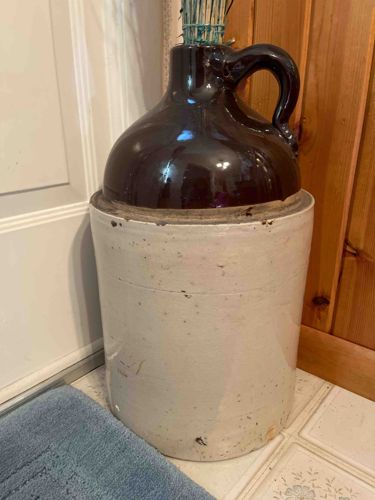
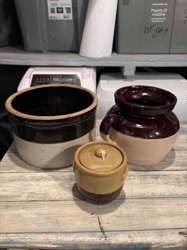
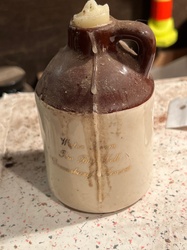
This item is a substantial stoneware crock, characterized by its two-tone glazing. The upper portion, including the neck, spout, and C-shaped handle, is finished with a rich, glossy dark brown glaze. The handle is robust and functionally integrated into the shoulder of the vessel. The body of the crock, from just below the shoulder to the base, is unglazed or finished with a matte, off-white to light gray slip. The overall form is cylindrical, tapering slightly towards the shoulder to meet the dark brown upper section. The dimensions appear to be considerable, suggesting a capacity suitable for bulk storage, likely several gallons. Visible condition issues include various dark specks and minor discolorations on the lighter body, which could be typical manufacturing imperfections, absorbed stains from use, or general age-related patina. There are no obvious cracks, chips, or repairs immediately discernible from the image, but the unglazed lower portion shows signs of surface wear and accumulated dirt, hinting at a long history of use. The craftsmanship appears sturdy and utilitarian, typical of earlier stoneware production. The interior of the mouth shows a collection of thin, green-accented decorative elements, likely dried grasses or similar floral arrangements, indicating its current decorative use. This type of stoneware, often referred to as a 'jug' or 'demijohn' when having a pour spout, or a 'crock' when having a wider opening, was commonly used for storing liquids like vinegar, oil, or spirits, as well as preserving foods. Its aesthetic suggests a late 19th to early 20th-century period, a time when stoneware was a prevalent material for household and commercial storage due to its durability and non-reactive properties. The quality is indicative of mass-produced yet functional stoneware of the era.
AI Appraisal Report
I have examined the image of this Large Two-Tone Stoneware Crock with Handle. Based on the visual evidence, it presents as a utilitarian piece of stoneware, likely dating from the late 19th to early 20th century. The two-tone glazing, with a dark brown upper portion and C-shaped handle, contrasts with the unglazed or light-slip body, which is characteristic of the period for storage vessels.
The condition appears fair to good for its age and type. I observe various dark specks and minor discolorations on the lighter body, consistent with manufacturing imperfections or absorbed stains from prolonged use. The unglazed lower portion shows expected surface wear and accumulated dirt, suggesting a history of practical application. Crucially, I don't observe any overt cracks, chips, or repairs, which is positive for its value.
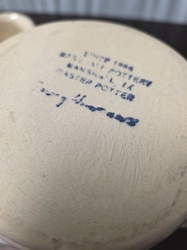
Authenticity, based solely on visual inspection, points strongly to a genuine period piece. These crocks were mass-produced. Market demand for utilitarian stoneware like this is generally stable but not exceptionally high. Similar crocks appear regularly in antique markets and online, with values largely dependent on size, condition, and any unique maker's marks, which are not visible here. Without a clearer view of the base or any potential impressed marks, attribution to a specific factory is impossible.
Factors impacting value include its substantial size, which is desirable, and the absence of major damage. The lack of decorative elements beyond the two-tone glaze limits its appeal beyond a rustic or historical aesthetic. My valuation reflects its good, used condition and its commonality in the market.
For full authentication, an in-person examination would be critical to thoroughly assess the surface for hairline cracks not visible in the image, check for repairs, and examine the base for any maker's marks or stamps. A tactile assessment would also confirm the material's integrity and assess the extent of surface grime versus absorbed stains. Without physical inspection, precise dating is an estimate, and any hidden damage remains unknown.