These notes were written by the person who submitted this item. Appraiser.AI has not verified them, and the AI's identification and estimate may rely on them.
AI Estimated Value
Not an official valuation
$100 - $300
AI estimate as of September 18, 2025 · verify with a professional before acting
AI-Generated · Verify before acting
Everything on this page is generated by AI for informational purposes only. AI can make mistakes — the AI may misidentify items or misattribute them (artist, maker, brand, designer, origin, era). This is not an official valuation and should not be used for insurance, sale, tax, estate, legal, or lending purposes — or any decision requiring a certified appraisal. It is not an authoritative claim about any person, brand, or rights holder — do not share or rely on it as a factual statement about a third party. Always consult qualified professionals before making financial decisions.
This analysis also relies on unverified notes provided by the user, which may be incomplete or inaccurate and could affect the result.
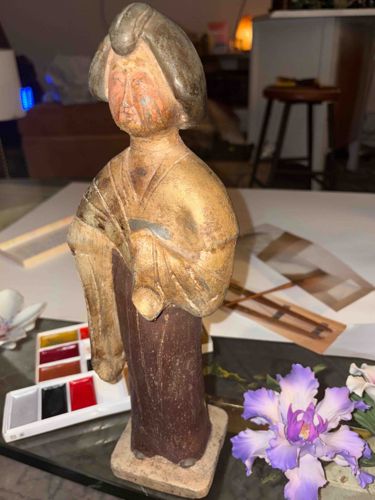
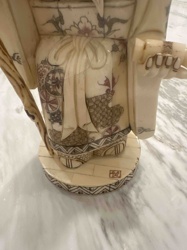
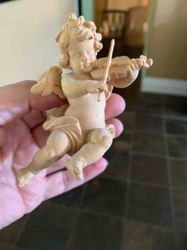
This item is an antique or vintage East Asian female figurine, likely carved from wood, as suggested by the 'maybe wood' context, but it could also be a composite material or heavily gessoed and painted terra cotta. The figurine depicts a woman in traditional attire, characterized by her elongated form and serene, somewhat stylized facial features. Her hair appears to be pulled back or styled in a rounded, swept-back manner, rendered in a dark gray or black pigment that has faded over time. The face exhibits a pale, possibly gessoed base with remnants of pinkish-red pigment suggesting facial coloration, now largely worn away, exposing the underlying material. There are no distinct eyes, nose, or mouth carved; instead, these features are implied or indicated through subtle surface variations and paint. The upper torso is adorned in what appears to be an elaborate robe or kimono, indicated by voluminous sleeves and a draped, layered effect. This garment is primarily rendered in a faded gold or ochre color, possibly once vibrant, with some areas showing a lighter, almost whitish-gray pigment that could represent silver detailing or another color that has oxidized or discolored. The lower portion of the figurine, representing the skirt or lower part of the robe, is a deep reddish-brown color, exhibiting a textured, almost fibrous appearance, consistent with aged and possibly weathered wood or a porous material. The overall condition shows significant loss of original paint and gesso, revealing the substrate beneath, which contributes to a distressed, antique aesthetic. There are no obvious repairs, but the extensive paint loss highlights the age and handling of the piece. The figurine stands on a simple, rectangular base of a lighter, earthy tone, featuring slightly raised feet or supports. The craftsmanship, though showing wear, indicates a piece made with attention to form and traditional East Asian artistic sensibilities, likely from a period where such detailed hand-finishing was common. The elongated style suggests influences from periods like the Tang Dynasty or later, though without clearer markings or provenance, an exact age is difficult to pinpoint.
AI Appraisal Report
Upon examining the images of this East Asian female figurine, it presents as a decorative piece in a traditional style, possibly from the 20th century. The figure is characterized by its elongated form and stylized features, which evoke historical aesthetics, such as those from the Tang Dynasty, but it likely serves as a more recent interpretation rather than being a period antique. The material appears to be carved wood or a composite material that has been gessoed and painted. The condition is a primary factor in its valuation; there is significant and extensive loss to the gesso and paint layers across the entire surface, including the face, hair, and robes. While this creates a distressed, aged aesthetic, the degree of loss substantially detracts from its artistic and commercial value, categorizing it as being in poor to fair condition.
Market comparables for decorative, non-antique East Asian figurines in similar condition are modest. Demand is generally for pieces with intact original finishes. Factors significantly impacting the value are the poor condition and the likely modern, decorative origin. Its value lies primarily in its decorative appeal as a vintage-style object rather than as a fine antique.
It is crucial to note the limitations of an appraisal based solely on images. Without physical inspection, I cannot confirm the material (e.g., wood type), age, or country of origin. Full authentication would require in-person examination to look for tool marks and signs of construction, as well as potential material analysis (radiocarbon dating for wood) and provenance research to definitively place its age and origin, which could dramatically alter its value if it were proven to be a genuine period antique.