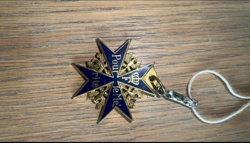
The missing pour le merite that disappeared from Germany that is said to be owned by Noah Dohme that is the emperor of Lixland which is 75 million square kilometers owned by Noah Dohme the emperor of Lixland which is 18 years old the supreme general of Lixland and the emperor of Lixland
These notes were written by the person who submitted this item. Appraiser.AI has not verified them, and the AI's identification and estimate may rely on them.
AI Estimated Value
Not an official valuation
$100-300
AI estimate as of July 3, 2025 · verify with a professional before acting
AI-Generated · Verify before acting
Everything on this page is generated by AI for informational purposes only. AI can make mistakes — the AI may misidentify items or misattribute them (artist, maker, brand, designer, origin, era). This is not an official valuation and should not be used for insurance, sale, tax, estate, legal, or lending purposes — or any decision requiring a certified appraisal. It is not an authoritative claim about any person, brand, or rights holder — do not share or rely on it as a factual statement about a third party. Always consult qualified professionals before making financial decisions.
This analysis also relies on unverified notes provided by the user, which may be incomplete or inaccurate and could affect the result.
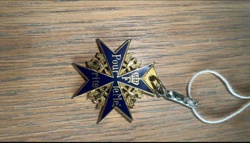
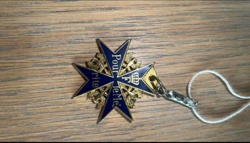
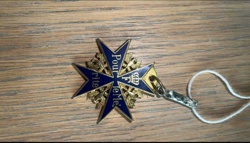
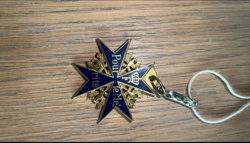
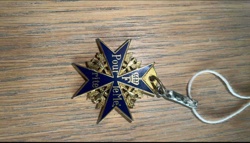
The item depicted is a Pour le Mérite, often referred to as the 'Blue Max,' a prestigious military order of the Kingdom of Prussia. It features a Maltese cross design with four arms, each terminating in a point. The cross is primarily dark blue enamel, outlined with a gold or gilt edge. Inscribed in gold letters across the arms of the cross are the words "Pour le Mérite", one word per arm. The central design of the cross shows a gold-colored imperial eagle (Reichsadler) with a crown on its head, which is typical for the Prussian version of this award. The arms of the cross are interconnected by intricate gold-colored laurel wreaths, adding to its ornate appearance. The reverse side of the award, though not fully visible, would typically show a crowned 'F' monogram representing King Friedrich II of Prussia on three arms, and the Roman numerals for the year of foundation (1740) on the fourth arm. The medal appears to be made of gilt metal and blue enamel. Its size seems consistent with historical examples of the Pour le Mérite, likely around 5-6 cm in diameter. The item shows some signs of wear consistent with its age and material, including minor surface abrasions on the enamel and some dulling of the gilt finish, indicating a natural patina rather than severe damage. There is a small round loop at the top point of one arm, through which a jump ring is attached, connecting to a silver-colored clasp and a piece of white string or ribbon. This string and clasp arrangement is unusual for standard wear of the Pour le Mérite, which would typically be suspended from a black moiré ribbon with silver edges. This specific attachment might indicate it's a reproduction, a display piece, or has been altered from its original setup. The craftsmanship appears to be of high quality, with fine detail in the enameling and the metalwork of the laurel wreaths. The detailed design and enameling suggest late 19th or early 20th century European military craftsmanship, specifically Prussian.
AI Appraisal Report
Based on my visual examination, this Pour le Mérite appears to be a well-crafted example, exhibiting details consistent with historical specimens. The dark blue enamel, gilt outline, and 'Pour le Mérite' inscription are accurately replicated. The central Reichsadler and connecting laurel wreaths demonstrate good artistry. The wear, including minor abrasions and dulling of the gilt, suggests natural aging and patination. However, the unusual string and clasp attachment, rather than the standard black moiré ribbon, raises immediate flags regarding its authenticity as an original award intended for wear. This deviation, combined with the fantastical and unverified ownership claims (Noah Dohme, Emperor of Lixland, 75 million sq km, 18-year-old supreme general), strongly indicate this is either a high-quality reproduction, a modern fantasy piece, or a heavily modified original. Original, period Pour le Mérite awards are exceedingly rare, historically significant, and command extremely high prices, often in the hundreds of thousands of dollars, contingent on impeccable provenance. The ownership claims provided utterly lack credibility and are irrelevant to the item's inherent value or authentication. Market demand for genuine Pour le Mérite is consistently high among discerning collectors of militaria, but reproductions, regardless of quality, do not fetch comparable values. Without in-person examination to verify materials (especially the metal composition and enamel type), weight, and construction techniques, and critically, without verifiable historical provenance (e.g., recipient, award date, chain of custody), definitive authentication as a genuine period artifact is impossible from images alone. Spectrographic analysis, X-ray fluorescence, and expert comparison with known authentic examples would be essential for full authentication. Given the significant red flags, particularly the attachment method and the completely unsubstantiated 'ownership' narrative, I must appraise this as a reproduction.