Japanese Satsuma-style Moriage Miniature Vase
Antique Japanese Ceramics

Japanese Satsuma-style Moriage Miniature Vase

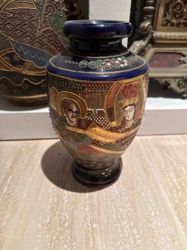
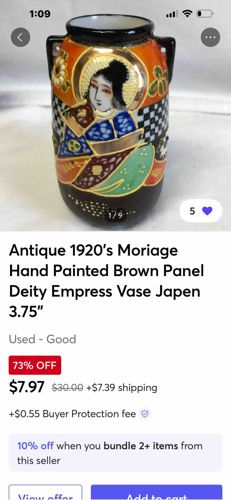
This is a small Japanese porcelain or earthenware vase, approximately 3.75 inches in height, featuring a complex decorative scheme typical of early 20th-century export ware from Japan. The vase is constructed in an ovoid form with two small integrated 'ear' handles at the rim. It is notable for its heavy moriage application—a technique involving raised, slip-trailed enamel used to create textured patterns on the surface. The central motif depicts a figure often identified as a 'Deity' or 'Imperial Empress' figures, rendered with a pale face and surrounded by a gilded halo. The surrounding decoration includes a mix of geometric patterns such as black-and-white checkerboards, cloud-like floral vignettes, and vibrant polychrome glazes in shades of cobalt blue, cinnabar red, and seafoam green. The base of the vase is finished in a deep chocolate brown or matte black glaze with gold dot accents. The craftsmanship represents a commercial grade of the Taisho or early Showa period (roughly 1920s), intended for Western markets. Visible condition issues include some thinning of the gilded accents at the rim and on the figure's halo, along with minor surface grime, though the moriage appears mostly intact. This style of pottery, often categorized broadly as Satsuma-style due to the gold-accented figure work, provides a tactile and visually dense example of Japanese porcelain craftsmanship from the interwar period.
Estimated Value

$45.00 - $75.00

Basic Information

Category

Antique Japanese Ceramics

Appraised On

January 23, 2026

Estimated Value

$45.00 - $75.00

Item Description

This is a small Japanese porcelain or earthenware vase, approximately 3.75 inches in height, featuring a complex decorative scheme typical of early 20th-century export ware from Japan. The vase is constructed in an ovoid form with two small integrated 'ear' handles at the rim. It is notable for its heavy moriage application—a technique involving raised, slip-trailed enamel used to create textured patterns on the surface. The central motif depicts a figure often identified as a 'Deity' or 'Imperial Empress' figures, rendered with a pale face and surrounded by a gilded halo. The surrounding decoration includes a mix of geometric patterns such as black-and-white checkerboards, cloud-like floral vignettes, and vibrant polychrome glazes in shades of cobalt blue, cinnabar red, and seafoam green. The base of the vase is finished in a deep chocolate brown or matte black glaze with gold dot accents. The craftsmanship represents a commercial grade of the Taisho or early Showa period (roughly 1920s), intended for Western markets. Visible condition issues include some thinning of the gilded accents at the rim and on the figure's halo, along with minor surface grime, though the moriage appears mostly intact. This style of pottery, often categorized broadly as Satsuma-style due to the gold-accented figure work, provides a tactile and visually dense example of Japanese porcelain craftsmanship from the interwar period.
Get Your Items Appraised

Instant estimates of your treasures with AI-powered instant appraisals

Browse More Appraisals