AI estimate as of December 1, 2025 · verify with a professional before acting
AI-Generated · Verify before acting
Everything on this page is generated by AI for informational purposes only. AI can make mistakes — the AI may misidentify items or misattribute them (artist, maker, brand, designer, origin, era). This is not an official valuation and should not be used for insurance, sale, tax, estate, legal, or lending purposes — or any decision requiring a certified appraisal. It is not an authoritative claim about any person, brand, or rights holder — do not share or rely on it as a factual statement about a third party. Always consult qualified professionals before making financial decisions.
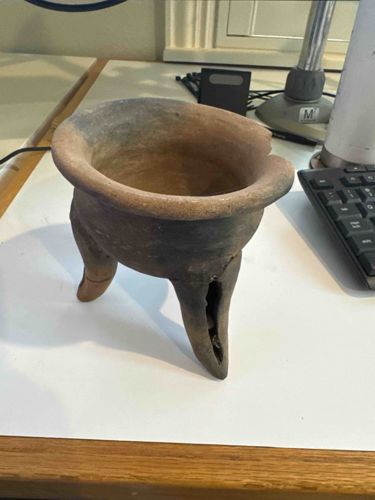
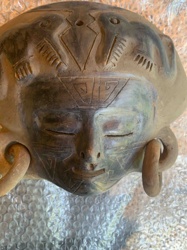
This item is an ancient tripod bowl, likely a form of incensario or small cooking vessel, crafted from terracotta. It exhibits a rustic and earthy aesthetic, consistent with hand-formed pottery techniques. The bowl features a flared rim, giving it a somewhat open-mouthed appearance, transitioning into a deeper body. The base is supported by three stout, slightly curved legs. The material appears to be unglazed, coarse terracotta, with colors ranging from a reddish-brown on the interior and rim to a darker, almost blackened brown on the exterior and legs, suggesting uneven firing or prolonged exposure to heat/soot. The surface shows considerable wear and unevenness, indicative of age and manual production. There are visible chips and irregularities along the rim and outer edges, particularly a prominent chip on the front-right side of the rim. The legs are solidly attached but appear to be an integral part of the vessel's construction, rather than being separately applied. One of the front legs has a notable elongated split or crack running vertically down its length. No explicit maker's marks or signatures are visible. The overall style and construction point towards an ancient or ethnographic origin, likely pre-industrial, possibly Mesoamerican or a similar cultural tradition. The craftsmanship is robust and functional, rather than purely decorative, suggesting practical use. The patination and surface imperfections contribute to its antique character, indicating significant age and past utility.
AI Appraisal Report
I have examined the provided image of this ancient terracotta tripod bowl, which appears to be either an incensario or a small cooking vessel. Based on my visual assessment, the item exhibits characteristics consistent with authentic hand-formed pottery from an ancient or ethnographic context. The unglazed finish, variations in color due to firing, and robust construction suggest practical utility rather than purely decorative intent. The significant wear, chips along the rim, surface irregularities, and the vertical split on one leg are all indicative of considerable age and use, contributing to its antique character.
Condition is fair to good, considering its age and reported function. The prominent chip on the rim and the leg split are notable but not unexpected for an item of this type. The overall aesthetic is rustic, appealing to collectors interested in archaeological or ethnographic pottery.
Regarding market conditions, pieces like this typically appeal to a niche market of collectors and institutions. Comparables for such unprovenanced, utilitarian ancient pottery, particularly without specific origin attribution, usually fall within a moderate price range. Demand is stable but not exceptionally high for generalized 'ancient' artifacts. Rarity is difficult to assess without specific cultural or geographical identification; while ancient, similar forms were produced across various cultures.
Factors significantly impacting value include the lack of specific provenance, which is a major limitation. Without documentation detailing its excavation, cultural attribution (e.g., Mayan, Aztec, pre-Columbian Andean), or even a clear date range, its value is significantly curtailed. The absence of maker's marks or decorative motifs also limits its appeal to specialized collectors.
My primary limitation in this appraisal is the lack of physical examination. While the visual cues strongly suggest authenticity, definitive authentication would require in-person examination to assess clay composition, manufacturing techniques, microscopic wear patterns, and residue analysis. Scientific dating methods, such as thermoluminescence dating, would be crucial for establishing a precise age. Without these, and critically, without provenance documentation, I cannot definitively confirm its age or cultural origin, nor rule out the possibility of it being a well-made reproduction or 'tourist art' from a more recent period. Such scientific testing and provenance could significantly increase its value.