AI Appraisal Estimate

AI-generated estimates · not official valuations

From the user

What was submitted

Photo and notes provided by the user — not generated by AI

Submitted item photo
Submitted photo · May 27, 2026

User's notes

No additional notes provided.

AI analysis below

AI appraisal

AI analysis & estimate

AI-Generated · Verify before acting

Everything below is generated by AI for informational purposes only. AI can make mistakes — the AI may misidentify items or misattribute them (artist, maker, brand, designer, origin, era). This is not an official valuation and should not be used for insurance, sale, tax, estate, legal, or lending purposes — or any decision requiring a certified appraisal. It is not an authoritative claim about any person, brand, or rights holder — do not share or rely on it as a factual statement about a third party. Always consult qualified professionals before making financial decisions.

Read the full disclaimer

AI Identification

·Not independently authenticated·Verify before acting

Letter of Authenticity for Pottery Statues

Document

AI Estimated Value

·Not an official valuation·Verify before acting

$0 - $20

As of May 27, 2026

AI Item Analysis

·AI can make mistakes·Verify before acting
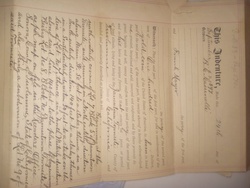
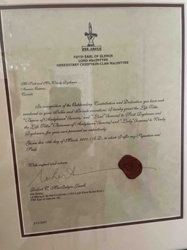
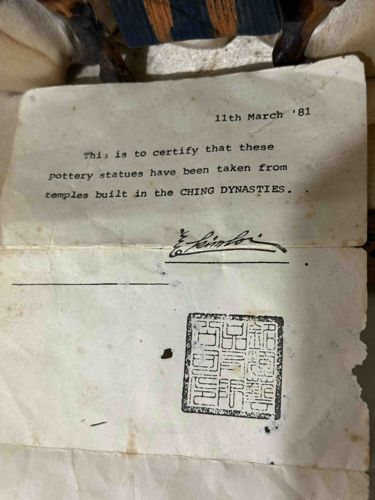
This item is a folded piece of aged paper, appearing to be a formal letter or certificate, dated '11th March '81'. The primary text states: 'This is to certify that these pottery statues have been taken from temples built in the CHING DYNASTIES.' Below this typed text, there is a handwritten signature in what appears to be black ink, although the specific characters are difficult to decipher clearly from the image provided. Further down on the document, a prominent, square-shaped black ink stamp or seal is visible. This seal features intricate Chinese characters arranged in a grid-like pattern, characteristic of traditional Chinese chops or seals used for official authentication. The paper itself shows signs of age and wear, including visible creases from folding, slight discoloration, and some minor tears or fraying along the edges, particularly towards the bottom right. There are a few small, dark specks on the paper that could be stains or dirt. The overall condition suggests that it is an older document, consistent with its dated claim. The context implies this document serves as a provenance or certification for accompanying pottery statues, suggesting their origin from temples constructed during the Qing (Ching) Dynasties, making it a crucial piece of supplementary information for antique or historical artifacts.
AI Appraisal Report

·AI can make mistakes·Verify before acting
Upon examining the provided image of this document, purporting to be a Letter of Authenticity for pottery statues, I have significant concerns regarding its legitimacy. The document is dated '11th March '81' and certifies statues from the 'CHING DYNASTIES'. However, numerous red flags undermine its credibility as a formal certificate of antiquity. The use of a standard typewriter, the simplistic phrasing, the anachronistic spelling 'CHING', and the generic nature of the statement do not align with professional or official authentication practices, even for the 1980s. Critically, the letter lacks any specific details about the statues themselves—no descriptions, dimensions, or photographs are included—making it impossible to link this document to any particular items. The signature is illegible, and there is no information about the issuing authority, rendering the stamp and signature unverifiable and essentially meaningless. From a market perspective, documents of this nature are considered supplementary at best and are often created after the fact to lend an air of legitimacy to items of questionable origin. Without verifiable provenance or the ability to authenticate the issuer, this paper holds no value as proof of the statues' origin. Its only potential value is as a curiosity or a decorative piece of ephemera, hence the nominal valuation. A full appraisal would require scientific analysis (paper, ink, and print method dating) and extensive provenance research into the issuer, neither of which is possible from the image alone. As presented, this document cannot be considered a credible certificate of authenticity and its impact on the value of any associated pottery is negligible, if not negative, as it may suggest a dubious history.

Get your items appraised

Instant estimates of your treasures with AI-powered appraisals

Browse More Appraisals