AI estimate as of August 26, 2025 · verify with a professional before acting
AI-Generated · Verify before acting
Everything on this page is generated by AI for informational purposes only. AI can make mistakes — the AI may misidentify items or misattribute them (artist, maker, brand, designer, origin, era). This is not an official valuation and should not be used for insurance, sale, tax, estate, legal, or lending purposes — or any decision requiring a certified appraisal. It is not an authoritative claim about any person, brand, or rights holder — do not share or rely on it as a factual statement about a third party. Always consult qualified professionals before making financial decisions.
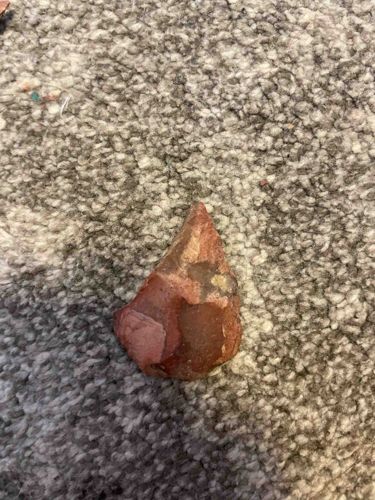
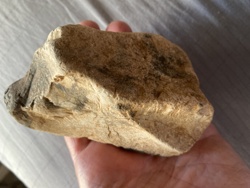
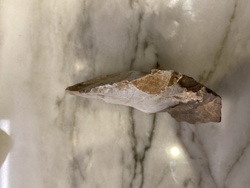
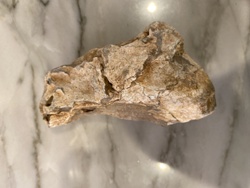
The item is a roughly triangular, tear-drop shaped stone artifact, most likely a projectile point or a preform for one. It measures approximately 2-3 inches in length based on its appearance relative to the carpet texture. The material appears to be a type of chert, jasper, or possibly quartzite, exhibiting a reddish-brown coloration with variations including lighter pinkish-red hues and mottled darker brown to yellowish-white inclusions or banding. The surface shows evidence of flake removals, indicative of knapping (flint-knapping) techniques used in shaping stone tools. The flaking appears to be somewhat coarse, suggesting a preform state or a less refined production quality for a finished projectile point. One side, forming the base of the 'tear drop,' is broader and appears to be the primary striking platform or a roughly finished base. The opposite end tapers to a relatively sharp, though not perfectly acute, point. There are visible irregularities and small fractures along the edges, consistent with typical wear, use, or the natural imperfections of the stone during knapping. The overall condition suggests a stable piece of stone, with no apparent fresh breaks or major damage; the 'patina' or surface alteration seems consistent with long-term exposure. No discernible maker's marks or modern alterations are visible. Given its appearance and manufacturing technique, it strongly resembles prehistoric lithic artifacts, likely from the Stone Age, possibly used by indigenous populations. The craftsmanship indicates functional rather than aesthetic intent.
AI Appraisal Report
Upon visual examination of the provided image, I assess this stone artifact as a preform or biface, consistent with prehistoric lithic technology. The reddish-brown chert/jasper/quartzite material, flake scar patterns, and overall morphology are highly indicative of an authentic Stone Age tool. Its condition appears stable, with surface alterations consistent with age rather than recent damage.
In terms of market conditions, similar authentic prehistoric projectile points or preforms typically find a niche market among collectors of Native American artifacts and archaeological enthusiasts. The ‘preform’ status, suggesting unfinished work or a less refined piece, generally places it at the lower end of the value spectrum compared to highly finished, iconic point types. Comparables would include undiagnostic bifaces or early-stage projectile points from various North American prehistoric periods.
Regarding demand and rarity, while prehistoric artifacts are not 'rare' in absolute terms, well-preserved examples with clear knapping evidence are always in demand. The lack of a distinct diagnostic type (e.g., Clovis, Folsom) and modest craftsmanship visible in the image mean its rarity is not exceptionally high within the broader category of lithic artifacts.
Factors significantly impacting value include the material's aesthetic quality (which is fair, with interesting mottling), the clarity of knapping skill (appears functional but not exemplary), and most notably the lack of provenance. Without knowing its origin (county, site, find context), its archaeological significance, and thus its market value, is severely limited.
Limitations in authenticity verification from images alone are substantial. I cannot definitively confirm the artifact's true age or rule out modern reproduction. A comprehensive in-person examination would involve microscopic analysis of flake scars, hinge fractures, and patination for evidence of modern tooling or replication. Petrographic analysis of the material could confirm geological origin. Most critically, verifiable provenance documentation (e.g., archaeological excavation records, well-documented collection history) is paramount for full authentication and maximizing value. Without such, it remains an 'out of context' artifact.