AI estimate as of October 25, 2025 · verify with a professional before acting
AI-Generated · Verify before acting
Everything on this page is generated by AI for informational purposes only. AI can make mistakes — the AI may misidentify items or misattribute them (artist, maker, brand, designer, origin, era). This is not an official valuation and should not be used for insurance, sale, tax, estate, legal, or lending purposes — or any decision requiring a certified appraisal. It is not an authoritative claim about any person, brand, or rights holder — do not share or rely on it as a factual statement about a third party. Always consult qualified professionals before making financial decisions.
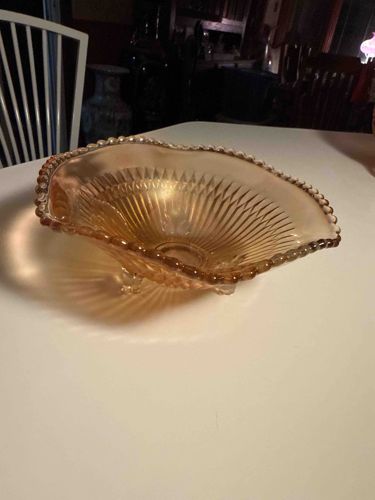
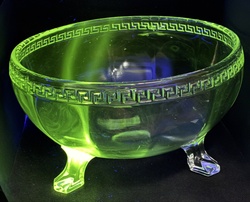
This item is an antique or vintage carnival glass bowl, characterized by its iridescent, golden-amber hue, often referred to as 'marigold' or 'peach opalescent' in carnival glass terminology. The bowl exhibits a distinct ruffled or crimped edge, which is accentuated by a continuous pattern of small, raised 'beads' or 'pearls' along the entire rim. The body of the bowl features a prominent rayed or fluted pattern radiating from the center outwards, giving it a sunburst or fan-like appearance. This intricate molding creates a captivating play of light and shadow, highlighting the glass's iridescence. From what is visible, the bowl appears to be raised on three small, molded feet, which contribute to its stability and decorative appeal. The overall shape is somewhat irregular and organic, typical of handmade or pressed glass items from the early 20th century. The glass itself is semi-translucent, allowing light to pass through and enhancing the iridescent effect. There are no immediate visible signs of major damage such as chips or cracks from the provided angles, but typical wear commensurate with age, such as minor scratches or surface abrasions, would be expected. The craftsmanship suggests it was produced using a pressed glass method, a common technique for carnival glass. The iridescence, achieved by applying metallic salts to the hot glass, is a key indicator of its carnival glass identity. Its style is consistent with the Art Nouveau or early Art Deco periods, typically dating from the early 1900s to the 1930s.
AI Appraisal Report
Based on my visual examination of the provided image, this Carnival Glass ruffled and footed bowl exhibits characteristics consistent with early 20th-century pressed glass. The 'marigold' or 'peach opalescent' iridescence, ruffled rim with 'beads' or 'pearls', and rayed body pattern are hallmarks of carnival glass. The three molded feet further contribute to its decorative appeal and typical construction for such pieces. Authenticity, based on the visual cues, appears strong; the iridescence and molding technique are correct for the period and style. Its semi-translucent nature and organic shape are also consistent. I do not observe any immediate major damage like chips or cracks from this perspective, suggesting good overall condition for its age. However, without physical inspection, minor surface wear, scratches, or subtle manufacturers' imperfections cannot be fully ruled out.
In terms of market conditions, carnival glass is a mature collecting area. While highly sought-after patterns or rare colors can fetch significant sums, more common patterns like a generic rayed design in marigold often fall into a wider, more accessible price range. Demand for general marigold carnival glass remains steady among collectors, but it is not considered exceptionally rare unless it is a piece from a scarce mold or maker. Factors significantly impacting value would include the specific manufacturer (absence of a maker's mark limits this determination from an image), the exact pattern name if identifiable (which is not clearly discernible here beyond 'rayed'), and absolute condition.
For full authentication and a definitive condition assessment, an in-person examination is crucial. This would allow me to check for stress cracks, internal flaws, specific mold marks, and the overall integrity of the glass not visible in photographs. Provenance documentation, though rarely available for these pieces, could also inform value. Considering typical market trends for common marigold carnival glass patterns in good, but not necessarily pristine, condition, I would estimate the appraisal value for this piece to be in the range of $40 to $70.