These notes were written by the person who submitted this item. Appraiser.AI has not verified them, and the AI's identification and estimate may rely on them.
AI Estimated Value
Not an official valuation
$800 - $1,500
AI estimate as of September 7, 2025 · verify with a professional before acting
AI-Generated · Verify before acting
Everything on this page is generated by AI for informational purposes only. AI can make mistakes — the AI may misidentify items or misattribute them (artist, maker, brand, designer, origin, era). This is not an official valuation and should not be used for insurance, sale, tax, estate, legal, or lending purposes — or any decision requiring a certified appraisal. It is not an authoritative claim about any person, brand, or rights holder — do not share or rely on it as a factual statement about a third party. Always consult qualified professionals before making financial decisions.
This analysis also relies on unverified notes provided by the user, which may be incomplete or inaccurate and could affect the result.
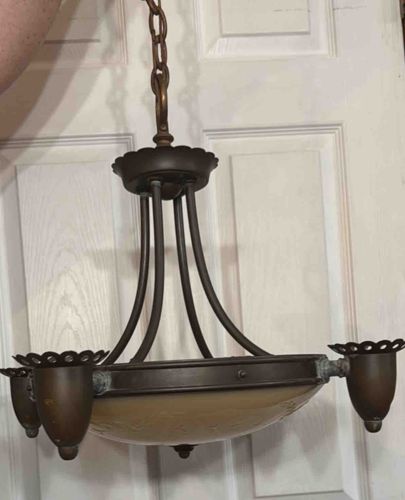
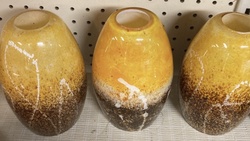
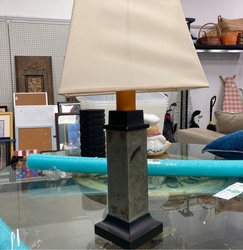
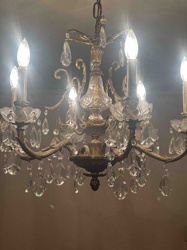
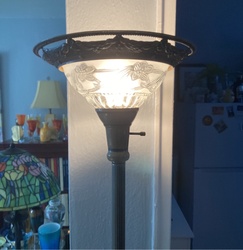
This appears to be a vintage chandelier, likely dating from the Art Deco period (1920s-1940s), which frequently incorporated streamlined designs and glass elements. The fixture features a central inverted bowl-shaped shade, described as uranium glass, suggesting a greenish hue under specific lighting conditions (e.g., UV light), though in natural light it presents with a translucent, light amber or milky off-white appearance with some mottled texture, indicating potential opalescence or a controlled swirl pattern in the glass. The metal components, including the chain, ceiling canopy, support arms, and four lamp holders, are crafted from a dark-toned metal, possibly brass or bronze with a rich, aged patina or an applied finish that gives it a deep brown or blackened bronze color. The central ceiling canopy has scalloped edges, a decorative detail echoed on the top rims of the four conical lamp holders that extend outwards from the main ring structure. These lamp holders are designed to house light bulbs, likely standard Edison screw base bulbs based on the era. Four gracefully curved metal rods connect the top canopy to the main circular frame that holds the glass bowl. The overall construction appears robust, assembled with visible hardware like small screws or rivets securing some metal sections. The visible condition suggests a natural aging process, with consistent patina across the metalwork and no obvious major dents or breaks, though closer inspection would be needed to confirm integrity of solder joints or connections. The glass bowl itself shows no apparent chips or cracks from this visual assessment. The quality of craftsmanship seems good, reflecting the typical mass-produced but still well-made lighting fixtures of its time, designed for both functionality and aesthetic appeal.
AI Appraisal Report
As an appraiser, I've examined the provided image and information regarding this Art Deco style chandelier, noting its uranium glass inverted bowl and dark-toned metalwork. Visually, the condition appears good; the metal exhibits a consistent, aged patina, suggesting natural wear without significant damage. The glass bowl appears intact, free from visible chips or cracks, and its description as 'translucent, light amber or milky off-white with mottled texture' aligns with the varied appearance of uranium glass in natural light. Authenticity as an Art Deco piece from the 1920s-1940s seems highly probable given the design elements – streamlined form, scalloped edges, and materials. The presence of uranium glass is a significant factor. While the owner states it is uranium glass, true verification requires UV light testing, as its appearance can be mimicked. Without a physical inspection, I cannot confirm the integrity of electrical components or internal structural integrity, nor can I definitively ascertain the metal composition (e.g., solid bronze vs. plated brass). Market demand for vintage Art Deco lighting, especially with unique elements like uranium glass, is generally strong. Comparables for similar multi-light chandeliers from this era in good condition range widely, but those with distinctive glass tend to fetch higher prices. Rarity is moderate; while Art Deco chandeliers are not uncommon, a piece with confirmed genuine uranium glass and in this condition would be less frequent. Factors positively impacting value are the apparent good condition, the Art Deco styling, and the unique appeal of uranium glass. Limitations from images alone are significant; full authentication would require in-person examination to test the glass with UV light, inspect wiring, assess metal quality (e.g., through magnet tests or detailed observation of manufacturing marks), and verify the absence of hidden repairs or damage. Provenance documentation, if available, would further strengthen authentication and value.