AI Appraisal Estimate

AI-generated estimates · not official valuations

From the user

What was submitted

Photo and notes provided by the user — not generated by AI

Submitted item photo
Submitted photo · June 15, 2026

User's notes

No additional notes provided.

AI analysis below

AI appraisal

AI analysis & estimate

AI-Generated · Verify before acting

Everything below is generated by AI for informational purposes only. AI can make mistakes — the AI may misidentify items or misattribute them (artist, maker, brand, designer, origin, era). This is not an official valuation and should not be used for insurance, sale, tax, estate, legal, or lending purposes — or any decision requiring a certified appraisal. It is not an authoritative claim about any person, brand, or rights holder — do not share or rely on it as a factual statement about a third party. Always consult qualified professionals before making financial decisions.

Read the full disclaimer

AI Identification

·Not independently authenticated·Verify before acting

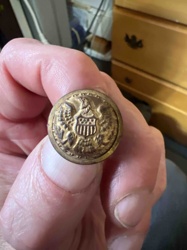
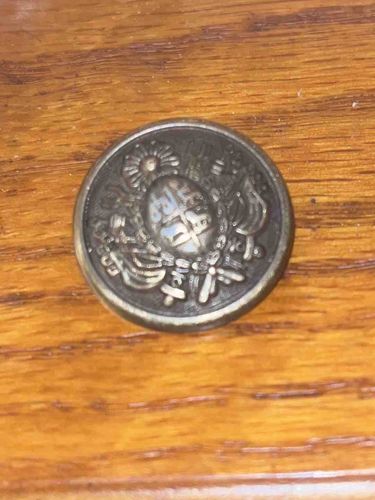
Vintage Japanese Military Police (Kenpeitai) Uniform Button

Military Memorabilia / Militaria

AI Estimated Value

·Not an official valuation·Verify before acting

$45.00 - $75.00

As of June 15, 2026

AI Item Analysis

·AI can make mistakes·Verify before acting
This is a circular, convex uniform button, likely from the Imperial Japanese era, specifically associated with the Kenpeitai (Military Police). The item is crafted from a copper-based alloy, commonly brass or bronze, and displays a prominent dark, aged patina with hints of golden metallic highlights peeking through on the raised surfaces. The design features a central oval shield bearing the stylized 'Ken' (law/police) kanji, topped by a sunburst or chrysanthemum motif. Flanking the shield are traditional military trophies, including crossed rifles or flags and a laurel wreath tied at the base with a bow. This specific iconography was characteristic of the Meiji to Showa eras (late 19th century to mid-20th century). The construction appears to be a two-piece pressed metal design, typical for high-quality military tailoring during that period. Condition-wise, the button shows authentic signs of wear, including minor surface abrasions and deep oxidation in the recessed areas, which actually enhances the legibility of the intricate relief. There are no visible maker's marks on the front; such marks are traditionally located on the reverse side (not pictured). The overall craftsmanship reflects the high standards of official government-issued regalia from early 20th-century Japan.
AI Appraisal Report

·AI can make mistakes·Verify before acting
I have conducted a visual examination of the provided Japanese Military Police (Kenpeitai) button. The piece exhibits the classic 'Ken' (law) kanji within a sunburst motif characteristic of the Imperial Japanese era. The construction represents a standard two-piece pressed metal design, and the heavy oxidation suggests a copper-alloy composition that has developed a natural, uncleaned patina over decades. The wear on the high-relief surfaces is consistent with legitimate field or dress use rather than modern reproduction aging. The market for Imperial Japanese militaria remains steady, though individual buttons are considered entry-level collectibles compared to full uniforms or katanas. Collectors specifically seek Kenpeitai items due to the unit's notorious historical reputation, which provides a slight premium over standard infantry buttons. Comparable sales for single brass buttons of this design typically range from $40 to $80, depending on the clarity of the reverse hallmark. A primary factor impacting value is the absence of a reverse-side view. Japanese military buttons often feature maker marks or arsenals (such as the Osaka Arsenal) that can significantly influence collector interest. While the iconography and wear patterns appear authentic, a definitive attribution requires a physical weight check and an examination of the shank attachment method. To fully authenticate this item, I would need to inspect the 'backmark' for period-correct font styles and perform a non-destructive metallurgical test to confirm the alloy isn't a modern zinc-based casting. Provenance documentation, such as a capture paper or vet-bring-back history, would further elevate the valuation toward the higher end of the spectrum.

Get your items appraised

Instant estimates of your treasures with AI-powered appraisals

Browse More Appraisals