AI Appraisal Estimate

AI-generated estimates · not official valuations

From the user

What was submitted

Photo and notes provided by the user — not generated by AI

Submitted item photo
Submitted photo · June 20, 2026

User's notes

No additional notes provided.

AI analysis below

AI appraisal

AI analysis & estimate

AI-Generated · Verify before acting

Everything below is generated by AI for informational purposes only. AI can make mistakes — the AI may misidentify items or misattribute them (artist, maker, brand, designer, origin, era). This is not an official valuation and should not be used for insurance, sale, tax, estate, legal, or lending purposes — or any decision requiring a certified appraisal. It is not an authoritative claim about any person, brand, or rights holder — do not share or rely on it as a factual statement about a third party. Always consult qualified professionals before making financial decisions.

Read the full disclaimer

AI Identification

·Not independently authenticated·Verify before acting

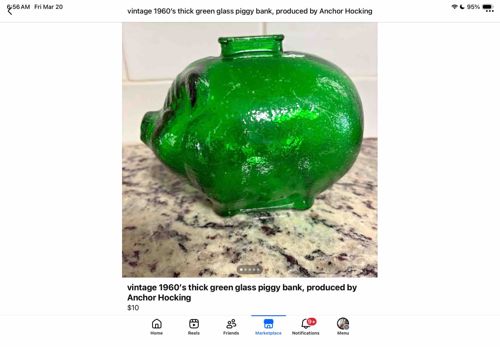
Vintage Anchor Hocking Forest Green Glass Piggy Bank

Vintage Glassware and Collectibles

AI Estimated Value

·Not an official valuation·Verify before acting

$45–$65

As of June 20, 2026

AI Item Analysis

·AI can make mistakes·Verify before acting
This is a vintage emerald or 'forest green' pressed glass piggy bank, attributed to Anchor Hocking and dating back to the 1960s. The item features a rounded, bulbous body with four molded stubby legs and a distinctive rectangular coin slot at the top. The glass is thick and heavy, characteristic of mid-century mass-produced utility glass. Architecturally, the piece shows a two-part mold construction with visible vertical seams running through the center of the face and back. The eyes and snout are detailed with simple molded indentations. The color is a deep, vibrant green that exhibits high transparency and bright highlights when exposed to light. Condition-wise, the external surfaces appear glossy with no major chips or cracks visible in the primary photo, though there is some light surface scuffing and minor internal residue common with age. The interior of the coin slot shows sharp edges typical of factory finishing. There are no decorative paints or cold-painted features, which is common for this specific mold. The lack of a bottom opening indicates that the bank was designed to be either decorative or required breaking to retrieve funds, a common trait for older glass banks which adds to their rarity when found intact. The craftsmanship is solid but functional, reflecting the industrial production standards of the era.
AI Appraisal Report

·AI can make mistakes·Verify before acting
Upon visual examination of this vintage piggy bank, I find the item to be a classic example of Anchor Hocking’s 'Forest Green' pressed glass series, likely produced during the late 1950s or 1960s. The deep, uniform color and the specific two-part mold construction—evidenced by the seam line bisecting the snout and back—are consistent with the mass-production techniques of the era. The piece appears to be in 'Excellent' condition; the glass retains high clarity and surface luster, with only minor scuffing that does not detract from its display value. The absence of a bottom aperture is a key feature, as many of these were destroyed to access the contents, making intact specimens more desirable for collectors. Market demand for mid-century utility glass remains steady, though this particular mold is relatively common compared to rarer colorways like Royal Ruby or Sapphire Blue. Comparable sales on local and online marketplaces typically fall within the $40 to $70 range depending on the presence of factory flaws like 'straw marks.' While the visual evidence strongly suggests authenticity based on mold geometry and color saturation, a physical inspection is required to definitively confirm the absence of subtle annealed cracks or modern reproductions. A full authentication would necessitate examining the piece for specific tactile indicators, such as the sharpness of the coin slot edges and the weight of the glass, which should be substantial for its size. No formal provenance was provided, but the item's physical characteristics align perfectly with the known catalog of Anchor Hocking utilitarian wares.

Get your items appraised

Instant estimates of your treasures with AI-powered appraisals

Browse More Appraisals