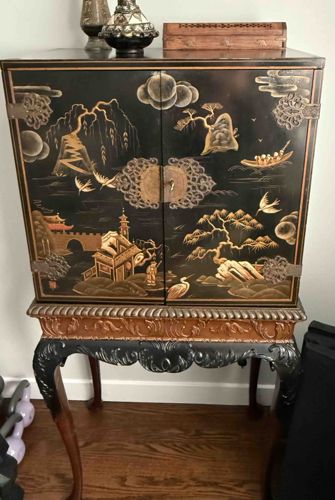
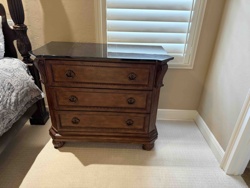
hand painted Asian cabinet, black lacquer with gold paint, smoke glass interior
These notes were written by the person who submitted this item. Appraiser.AI has not verified them, and the AI's identification and estimate may rely on them.
AI Estimated Value
Not an official valuation
$800-1,200
AI estimate as of August 23, 2025 · verify with a professional before acting
AI-Generated · Verify before acting
Everything on this page is generated by AI for informational purposes only. AI can make mistakes — the AI may misidentify items or misattribute them (artist, maker, brand, designer, origin, era). This is not an official valuation and should not be used for insurance, sale, tax, estate, legal, or lending purposes — or any decision requiring a certified appraisal. It is not an authoritative claim about any person, brand, or rights holder — do not share or rely on it as a factual statement about a third party. Always consult qualified professionals before making financial decisions.
This analysis also relies on unverified notes provided by the user, which may be incomplete or inaccurate and could affect the result.
This is a hand-painted Asian-style cabinet, likely a side cabinet or bar cabinet, featuring a prominent black lacquer finish adorned with extensive gold and colored paint decoration. The cabinet takes the form of a rectangular upper case, narrower at the top and widening towards the base, resting upon a distinct, carved leg stand. The front doors of the cabinet are the primary focal point, displaying an elaborate Chinoiserie landscape scene. This scene depicts mountains, stylized clouds, trees, architectural elements like bridges and pagodas, boats with figures, various birds (including what appears to be a crane), and human figures engaged in activities. The detailed painting suggests a good level of craftsmanship. The hardware for the doors includes ornate, possibly brass or bronze, escutcheon plates and hinges, which are also incorporated into the overall design. Below the cabinet body, there is a richly carved frieze in a lighter color, appearing to be a gilded or faux-gilded finish, with scrolling motifs, which contrasts strikingly with the dark lacquer. The cabinet is supported by four cabriole-style legs, which are also heavily carved and finished in black, matching the main cabinet body. One leg clearly visible shows significant wear or discoloration, differing from the black finish of the other visible legs, suggesting either a repair, an intended two-tone finish, or simply wear and tear. The cabinet is stated to have a 'smoke glass interior', indicating a functional internal space, likely shelves or compartments, with tinted glass. The overall style suggests an influence from traditional Chinese furniture design, adapted for a Western market, possibly dating from the mid-20th century or later due to the more stylized and less traditional depiction of subjects. The 'hand-painted' aspect points to individual artistry rather than mass production methods, potentially increasing its decorative value. Observable condition issues include the previously mentioned discoloration or wear on the leg and general surface wear consistent with age and use.
AI Appraisal Report
Upon examining the Hand-Painted Black Lacquer Asian-Style Bar Cabinet, I observe a charming decorative piece. The vivid Chinoiserie landscape scene in gold and colored paints on the black lacquer is undoubtedly the focal point, showcasing skillful hand-painting that elevates its aesthetic appeal over mass-produced alternatives. The carved leg stand, particularly with the contrasting lighter frieze, adds significant visual interest.
From the image, the overall condition appears good for its age, though I note the visible wear/discoloration on one cabriole leg, which requires closer inspection. This could be surface wear, a past repair, or an indicator of material variation. Authenticity as a true antique is difficult to ascertain from images alone; the 'stylized' nature of the depiction suggests a mid-20th century or later decorative piece rather than an early Qing or Edo period original. The 'smoke glass interior' detail points to more modern conveniences.
In the current market, items of this decorative style, particularly those with hand-painted details, maintain a consistent demand. While not rare as a category, the specific quality of the hand-painting and the intact state of the lacquer work differentiate it from lower-quality reproductions. Comparables in the decorative furniture market suggest a strong interest in Asian-inspired pieces for their unique visual appeal.
For a full authentication, I'd require a physical examination to properly assess the lacquer's age, the construction techniques, wood species, and verify the material of the metal hardware. Provenance documentation could further establish its history and origin. Scientific testing, if necessary, could confirm period-specific pigments or materials. Without such authentication, the value leans towards its decorative merit rather than its historical significance as a period antique.