AI estimate as of November 5, 2025 · verify with a professional before acting
AI-Generated · Verify before acting
Everything on this page is generated by AI for informational purposes only. AI can make mistakes — the AI may misidentify items or misattribute them (artist, maker, brand, designer, origin, era). This is not an official valuation and should not be used for insurance, sale, tax, estate, legal, or lending purposes — or any decision requiring a certified appraisal. It is not an authoritative claim about any person, brand, or rights holder — do not share or rely on it as a factual statement about a third party. Always consult qualified professionals before making financial decisions.
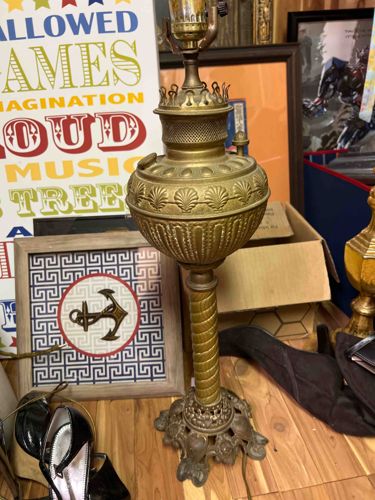
This is an antique brass lamp, likely a former oil lamp that has been converted to electricity, as evidenced by the modern electrical socket components at the top. The lamp features a prominent, bulbous body adorned with intricate decorative motifs. The upper section of the body exhibits a grid-like pattern, possibly ventilation for an original oil mechanism, topped with a burner assembly that now houses the electrical components. Below this, there is a band of repeated scallop shell designs, suggesting a Victorian or Edwardian aesthetic. The lower part of the body features vertical fluting, adding to its elaborate appearance. The lamp stands on a tall, twisted or spiral-fluted column, which reinforces its historical design. The base is an ornate, cast metal structure with four claw-like feet, indicative of late 19th to early 20th-century craftsmanship. The overall material appears to be brass, showing a significant amount of patina, discoloration, and oxidation consistent with age, indicating it has not been recently polished. Some areas show a darker, almost brown-black appearance in the crevices, highlighting the age and lack of extensive restoration. There are no clear maker's marks or signatures visible in the provided image. The conversion to an electric lamp likely occurred after its original manufacture, making it a functional piece while retaining its antique charm. The craftsmanship suggests a manufactured item, possibly from a larger production run, given the uniformity of the decorative castings.
AI Appraisal Report
Based on my visual examination of the provided image, this antique brass lamp, originally an oil lamp and subsequently converted to electricity, appears to be a manufactured item from the late 19th to early 20th century. The intricate decorative motifs, including the scallop shell band, vertical fluting, twisted column, and ornate claw-footed base, are consistent with Victorian or Edwardian aesthetics. The brass material exhibits significant patina, discoloration, and oxidation, indicating genuine age and lack of recent polishing, which contributes positively to its antique character.
My assessment of its condition, purely from the image, suggests it is structurally sound, though the electrical conversion would need professional inspection for safety and functionality. The conversion itself, while practical, generally diminishes the value of an original oil lamp, as collectors often prefer untouched examples. However, for a user, it enhances utility without significant aesthetic compromise here.
Market conditions for converted oil lamps can be variable. While original, functional oil lamps in excellent condition command higher prices, converted pieces have a niche market among those seeking decorative antique lighting for contemporary use. Comparables typically range from $100 for more common examples to $300-$400 for exceptionally well-preserved or unusually styled pieces. Demand is moderate, as these items are decorative but not exceedingly rare collectors' pieces. Key factors impacting value here are the attractive design, the visible age and patina, and the professional-looking conversion.
Limitations in authenticity verification are significant. Without an in-person examination, I cannot confirm the material composition definitively, inspect for repairs, damage not visible in the image, or verify the quality of the electrical conversion. A physical inspection would allow me to check for maker's marks, assess the integrity of the brass, and evaluate the electrical components for safety and compliance. Provenance documentation, if available, would further enhance its historical context and value.