These notes were written by the person who submitted this item. Appraiser.AI has not verified them, and the AI's identification and estimate may rely on them.
AI Estimated Value
Not an official valuation
$5 - $15
AI estimate as of November 2, 2025 · verify with a professional before acting
AI-Generated · Verify before acting
Everything on this page is generated by AI for informational purposes only. AI can make mistakes — the AI may misidentify items or misattribute them (artist, maker, brand, designer, origin, era). This is not an official valuation and should not be used for insurance, sale, tax, estate, legal, or lending purposes — or any decision requiring a certified appraisal. It is not an authoritative claim about any person, brand, or rights holder — do not share or rely on it as a factual statement about a third party. Always consult qualified professionals before making financial decisions.
This analysis also relies on unverified notes provided by the user, which may be incomplete or inaccurate and could affect the result.
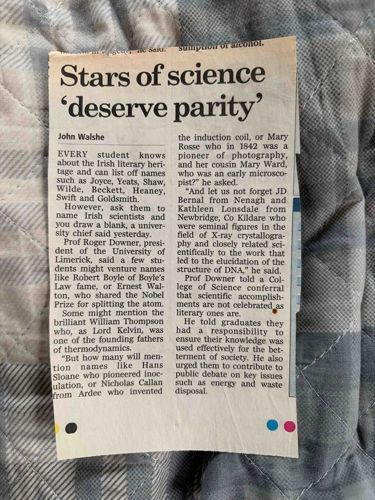
This item is a rectangular fragment of newsprint featuring an article titled "Stars of science 'deserve parity'" by John Walshe. The article discusses a disparity in public recognition between Irish literary figures and Irish scientists, citing a university chief's assertion that students widely recall literary names but struggle to identify scientific pioneers. It mentions several prominent Irish scientists such as Robert Boyle, Ernest Walton, Lord Kelvin (William Thompson), Hans Sloane, Nicholas Callan, Mary Rosse, Mary Ward, JD Bernal, and Kathleen Lonsdale, highlighting their significant contributions to various scientific fields including physics, photography, and X-ray crystallography related to DNA structure. The visible portion of the newsprint is off-white to a light cream color, suggesting some age or exposure to light. The text is printed in black ink, featuring a large, bold serif typeface for the headline and a smaller, standard serif font for the body text. The article is organized into two main columns, typical of newspaper layouts. At the bottom edge, below the right column, visible cyan and magenta CMYK color registration marks indicate it was printed using a four-color process, common for modern newspapers. The left edge of the visible newspaper fragment is torn and irregular, while the top and right edges appear to be cut, although potentially exhibiting slight fraying. The bottom edge is also irregularly torn. The paper itself shows signs of creasing and crumpling, particularly visible in the overall image, indicating handling and wear. The background of the image reveals a patterned fabric, possibly a blanket or quilt, which provides context for the item's current storage or display. Given the printing style and content, it likely dates from the late 20th or early 21st century. The quality of the print is clear and legible despite the paper's physical condition.
AI Appraisal Report
I have examined the provided image of the newspaper fragment titled "Stars of science 'deserve parity'". Based on my visual assessment, the item appears to be an authentic piece of newsprint, evidenced by its physical characteristics such as the paper's texture, printing style, and visible CMYK registration marks. The off-white/light cream color and general creasing and crumpling indicate some age and handling, consistent with a used newspaper clipping. The print quality is clear and legible.
The market for newspaper clippings of this nature is generally low. While the article discusses notable Irish scientists, it is a common news report rather than a rare or historically significant document itself. Comparables would include other salvaged newspaper articles, which typically hold minimal monetary value unless they report on exceptionally rare, iconic, or historically pivotal events, or feature signatures or unique provenance.
Demand for this specific item is likely very limited, primarily appealing to niche collectors interested in particular scientific figures mentioned or local Irish history. Rarity is not a factor here; newsprint is produced in vast quantities. The primary factors impacting value negatively are its common nature, fragmented state, and lack of unique distinguishing features.
Limitations in authenticity verification from images alone exist. While the visual evidence strongly suggests authenticity as a newspaper clipping, an in-person examination would allow for tactile inspection of the paper's fiber, ink adhesion, and detailed analysis of wear patterns to confirm its age and material composition unequivocally. Provenance documentation, such as where and when it was clipped, could add marginal historical context but would not significantly alter its monetary value due to the item's common nature.