Trench Watch with Bund-Style Leather Strap
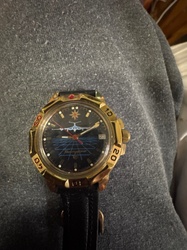
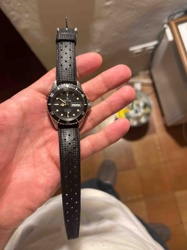
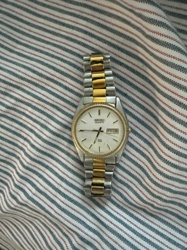
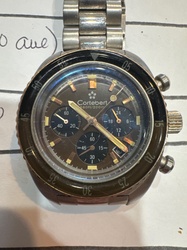
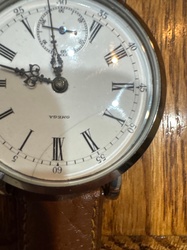
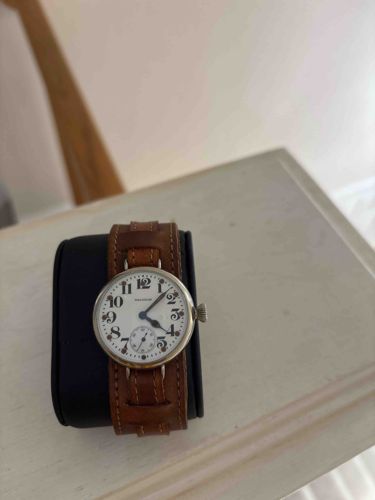
This is a vintage 'trench' style wristwatch, a transitional timepiece design from the early 20th century (circa 1910s-1920s) that converted pocket watch movements for wrist wear. The watch features a white enamel or ceramic dial with bold, stylized black Arabic numerals and a sub-dial at the 6 o'clock position for seconds. The brand name 'Waltham' is partially visible on the upper quadrant of the dial. It is housed in a polished nickel or silver-toned metal case with a distinctive oversized onion-style winding crown. The watch is mounted on a wide, thick brown leather 'Bund' or 'trench' strap, which was originally designed to protect the wearer’s skin from extreme temperatures and to protect the watch from moisture. The strap shows significant signs of age and patina, with darkening of the leather and visible stitching. Condition-wise, the dial exhibits some minor discoloration or 'foxing' near the numerals, and the case shows light surface scratches consistent with age. This piece exemplifies the craftsmanship of early portable timekeeping, transitioning from the Victorian era to the utilitarian needs of World War I.
AI-Generated Appraisal Disclaimer
Estimated Value
$450 - $700
Basic Information
Category
Horology - Vintage Wristwatches
Appraised On
January 22, 2026
Estimated Value
$450 - $700
Item Description
This is a vintage 'trench' style wristwatch, a transitional timepiece design from the early 20th century (circa 1910s-1920s) that converted pocket watch movements for wrist wear. The watch features a white enamel or ceramic dial with bold, stylized black Arabic numerals and a sub-dial at the 6 o'clock position for seconds. The brand name 'Waltham' is partially visible on the upper quadrant of the dial. It is housed in a polished nickel or silver-toned metal case with a distinctive oversized onion-style winding crown. The watch is mounted on a wide, thick brown leather 'Bund' or 'trench' strap, which was originally designed to protect the wearer’s skin from extreme temperatures and to protect the watch from moisture. The strap shows significant signs of age and patina, with darkening of the leather and visible stitching. Condition-wise, the dial exhibits some minor discoloration or 'foxing' near the numerals, and the case shows light surface scratches consistent with age. This piece exemplifies the craftsmanship of early portable timekeeping, transitioning from the Victorian era to the utilitarian needs of World War I.
Get Your Items Appraised
Instant estimates of your treasures with AI-powered instant appraisals