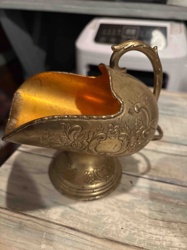
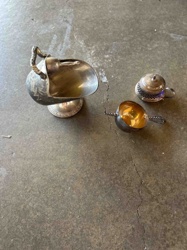
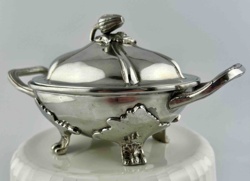
Silver plate antique James Dixon and son’s teapot sugar scuttle butter dish
These notes were written by the person who submitted this item. Appraiser.AI has not verified them, and the AI's identification and estimate may rely on them.
AI Estimated Value
Not an official valuation
$300-500
AI estimate as of September 26, 2025 · verify with a professional before acting
AI-Generated · Verify before acting
Everything on this page is generated by AI for informational purposes only. AI can make mistakes — the AI may misidentify items or misattribute them (artist, maker, brand, designer, origin, era). This is not an official valuation and should not be used for insurance, sale, tax, estate, legal, or lending purposes — or any decision requiring a certified appraisal. It is not an authoritative claim about any person, brand, or rights holder — do not share or rely on it as a factual statement about a third party. Always consult qualified professionals before making financial decisions.
This analysis also relies on unverified notes provided by the user, which may be incomplete or inaccurate and could affect the result.
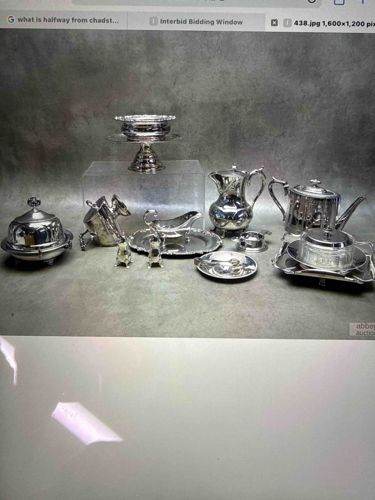
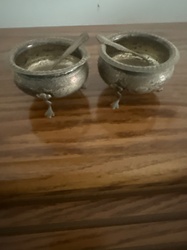
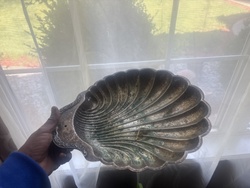
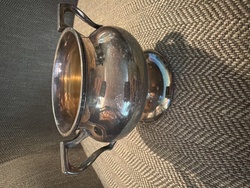
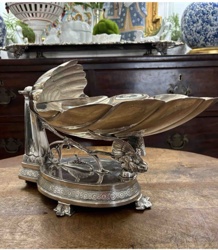
This collection comprises various silver-plated items, likely produced by the reputable firm James Dixon and Sons, given the context. The grouping includes a diverse range of serving pieces, predominantly in a Victorian or Edwardian style, characterized by ornate detailing and a polished, reflective finish. Key items visible are a lidded butter dish with a domed cover and ornate finial, resting on a footed base; a gravy boat or sauce boat with an elegant handle and an associated serving tray; a creamer and sugar bowl set, both featuring curved handles and a bulbous body, likely for serving coffee or tea. Additionally, there appear to be two smaller, possibly salt and pepper shakers or condiment caddies, and a low-profile pedestal dish, which could be a compote or a serving dish for fruits or confectionery. The overall construction suggests electroplated silver on a base metal, commonly employed during the late 19th to early 20th century. The intricate patterns, featuring scrolls, foliage, and possibly fluting, indicate a commitment to traditional craftsmanship. Visible condition issues are difficult to discern definitively from the image, but some pieces exhibit slight tarnish, which is typical for antique silver plate. No overt damage such as dents or significant plating loss is immediately apparent, suggesting a well-maintained collection. The uniform aesthetic across most pieces implies they could have been part of a larger original service or acquired as matching sets. The quality of electroplating from manufacturers like James Dixon and Sons was generally high, offering durable and attractive tableware to a broader market than solid silver.
AI Appraisal Report
I have examined the provided image of this Assorted James Dixon and Sons Silver-Plated Tableware Collection. The collection appears to be a genuine assortment of late 19th to early 20th-century electroplated silver pieces from James Dixon and Sons, a well-regarded manufacturer. The visible items – a lidded butter dish, gravy boat with tray, creamer, sugar bowl, two smaller caddies/shakers, and a pedestal dish – exhibit the characteristic ornate detailing, such as scrolls and foliage, typical of Victorian/Edwardian aesthetics. Based on the image, the condition appears generally good, with some expected tarnishing but no obvious dents or significant plating loss, suggesting good maintenance over time. However, a detailed assessment of plating wear, especially on high-contact areas and feet, cannot be definitively made without physical inspection. The uniformity of style lends credence to the idea that these pieces may have originated from a larger service or matching sets.
Market conditions for antique silver-plated tableware are currently moderate. While James Dixon and Sons is a reputable name, silver plate generally commands lower prices than sterling silver. Demand is driven by collectors and individuals seeking decorative historical pieces for home decor. The collection’s diverse components offer functional and aesthetic appeal, which can enhance desirability. However, silver-plated items, even from good manufacturers, are not considered rare.
The most significant factors impacting value are the overall condition of the plating (minimal wear is preferred), the completeness of any original sets, and the intricacy of the design. The absence of a teapot, mentioned in the owner's description but not clearly visible or easily identifiable, could slightly affect the perceived value if it were part of a full tea service.
It is crucial to note that authenticity verification and precise condition assessment are limited by image-based examination. Without an in-person examination, it's impossible to confirm manufacturer's marks definitively, gauge the extent of plating loss, or detect subtle repairs. Provenance documentation could bolster authenticity, and scientific testing would be needed only in cases of extreme doubt regarding material composition, which is not suggested here.