AI Appraisal Estimate

AI-generated estimates · not official valuations

From the user

What was submitted

Photo and notes provided by the user — not generated by AI

Submitted item photo
Submitted photo · June 4, 2026

User's notes

No additional notes provided.

AI analysis below

AI appraisal

AI analysis & estimate

AI-Generated · Verify before acting

Everything below is generated by AI for informational purposes only. AI can make mistakes — the AI may misidentify items or misattribute them (artist, maker, brand, designer, origin, era). This is not an official valuation and should not be used for insurance, sale, tax, estate, legal, or lending purposes — or any decision requiring a certified appraisal. It is not an authoritative claim about any person, brand, or rights holder — do not share or rely on it as a factual statement about a third party. Always consult qualified professionals before making financial decisions.

Read the full disclaimer

AI Identification

·Not independently authenticated·Verify before acting

Vintage Solid Brass Wall Crucifix

Religious Artifacts & Metalware

AI Estimated Value

·Not an official valuation·Verify before acting

$45.00 - $75.00

As of June 4, 2026

AI Item Analysis

·AI can make mistakes·Verify before acting
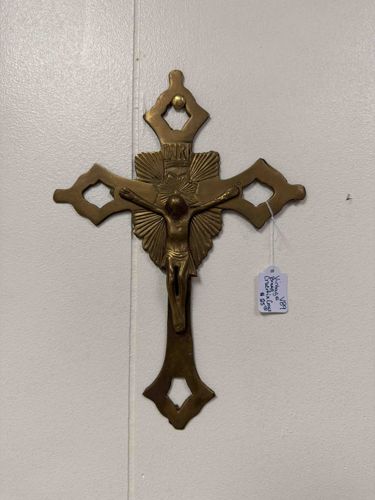
This is a mid-20th-century wall-mounted crucifix crafted from cast brass, exhibiting a warm, aged golden-brown patina. The design features a stylized Gothic-inspired cross with quatrefoil-shaped cutouts at the end of each arm. At the center of the cross, a radiant 'sunburst' or glory halo emanates from behind the figure of Jesus Christ. Above the corpus is a banner inscribed with 'INRI', representing the Latin phrase 'Iesus Nazarenus, Rex Iudaeorum'. The figure of Christ is cast with moderate anatomical detail, showing a draped loincloth and traditional posture. The construction appears to be a multi-part assembly, likely with the corpus and sunburst joined to the main cross body via rivets or screws, though the mounting hardware at the top is a simple visible brass fastener used for hanging. Regarding condition, the metal shows various surface abrasions, small pits consistent with the sand-casting process, and localized areas of darker oxidation and tarnish, particularly in the recessed decorative grooves. There are no signs of structural repair, but the overall wear suggests significant age, likely dating from the 1950s to 1970s. The craftsmanship is consistent with mass-produced ecclesiastical decorative arts of that era, intended for domestic devotional use.

AI Appraisal Report

·AI can make mistakes·Verify before acting
I have virtually examined this mid-20th-century solid brass wall crucifix. Based on the provided description and visual characteristics, the item appears to be an authentic example of domestic ecclesiastical metalware common between 1950 and 1970. The cast brass construction shows a pleasing natural patina, with surface abrasions and oxidation consistent with its age and use in a household environment. The stylized Gothic quatrefoils and radiant 'glory' halo suggest it was a mass-produced item intended for the Catholic devotional market. The current market for mid-century religious brass is stable but saturated. Similar pieces are frequently found in estate sales and antique malls. While the 'INRI' banner and multi-part assembly add more visual interest than simpler modern castings, the item lacks a maker’s mark (such as those from renowned firms like Gorham or Rambusch) that would elevate its value into a higher tier. The condition is fair to good; the pitting and tarnish are typical of sand-casting and do not detract significantly from its value, though they prevent a 'mint' valuation. Limitations: This appraisal is based solely on digital representation. I cannot verify the exact metal alloy or detect hidden repairs or lead-based solder used in the assembly without a physical inspection. To finalize a definitive valuation, I would require an in-person examination to check for foundry marks, weight verification (to confirm solid brass versus plated spelter), and documentation of provenance. No scientific testing is recommended given the item's likely market value, which is driven primarily by its aesthetic and devotional appeal rather than rarity.

Get your items appraised

Instant estimates of your treasures with AI-powered appraisals

Browse More Appraisals