AI estimate as of October 14, 2025 · verify with a professional before acting
AI-Generated · Verify before acting
Everything on this page is generated by AI for informational purposes only. AI can make mistakes — the AI may misidentify items or misattribute them (artist, maker, brand, designer, origin, era). This is not an official valuation and should not be used for insurance, sale, tax, estate, legal, or lending purposes — or any decision requiring a certified appraisal. It is not an authoritative claim about any person, brand, or rights holder — do not share or rely on it as a factual statement about a third party. Always consult qualified professionals before making financial decisions.
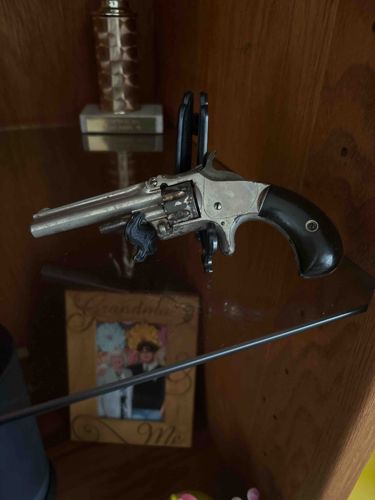
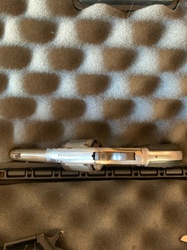
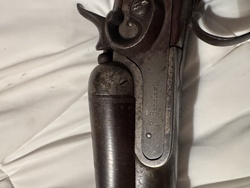
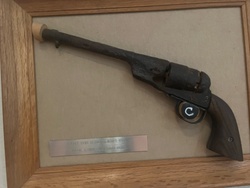
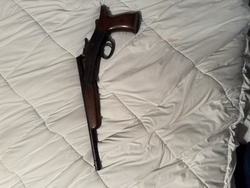
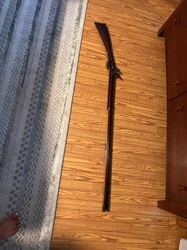
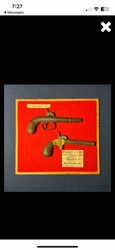
The item is an antique revolver, likely a small caliber 'pocket pistol' or 'suicide special' type, often referred to as an 'Owl Head' model due to the characteristic grip design featuring an 'owl head' motif (though not clearly visible in this image, it's a common characteristic of revolvers from this era with similar aesthetics). It appears to be constructed primarily of metal, possibly nickel-plated or tarnished steel, exhibiting a dull silver-gray coloration with significant patina and some areas of dark discoloration, indicative of age and potential surface oxidation. The grips are dark, likely made of hard rubber or bakelite, with a smooth surface and a single screw visible on the right side. The hammer is exposed, and the trigger mechanism seems to be a spur-trigger type, common in early revolvers. The cylinder is visible and appears to be a five-shot fluted cylinder. Visible condition issues include widespread surface wear, tarnishing, and some pitting, particularly on the frame and barrel. There's also some blue thread or string tied around the trigger guard area, which is an external addition and not part of the original firearm. The overall size appears compact, typical of self-defense pistols from the late 19th to early 20th century. No clear manufacturer's marks or serial numbers are visible in the provided image. The revolver is consistent with firearms produced between approximately 1870 and 1920, often by companies like Iver Johnson, Harrington & Richardson, or similar manufacturers of inexpensive, mass-produced revolvers of that period. Its craftsmanship suggests a utilitarian production rather than high-end artistry.
AI Appraisal Report
Upon visual examination of the provided image, I assess this antique 'Owl Head' revolver. Authenticity, based solely on visual cues, appears consistent with late 19th to early 20th-century American-made pocket revolvers, commonly produced by companies such as Iver Johnson or Harrington & Richardson. The overall form, exposed hammer, spur trigger, and fluted five-shot cylinder are characteristic of these 'suicide special' types.
The condition is fair to poor. The metal surfaces exhibit significant tarnish, wear, and what appears to be widespread pitting or surface oxidation, particularly visible on the frame and barrel. The dark grips seem intact but show no fine detail. The presence of a blue thread tied around the trigger guard is a detractor, indicating post-manufacture modification or storage method. No specific manufacturer markings or serial numbers are discernible, which limits precise identification.
Market conditions for these utilitarian revolvers are generally modest. While they hold historical interest as examples of period self-defense firearms, they are not exceedingly rare. Comparables in similar condition typically fetch prices in the lower hundreds, with higher values reserved for examples in very good to excellent condition, with clear manufacturer markings, original finish, and documented provenance. The lack of clear 'owl head' motif, coupled with the heavy surface degradation, places this example at the lower end of the value spectrum for this type.
Factors significantly impacting value negatively are the poor surface condition, lack of clear identifying marks, and the generic nature of what appears to be a mass-produced item. Demand is primarily from collectors focusing on historical firearms, but not usually at a premium for examples in this condition.
Limitations in authenticity verification are significant due to image-only examination. A physical in-person examination would be critical to confirm: 1) the true condition, including internal mechanisms and bore; 2) the presence of any faint manufacturer's markings or serial numbers vital for positive identification and dating; 3) the material composition and integrity of the grips; and 4) to rule out any modern reproductions or extensively altered pieces. Provenance documentation, such as original sales receipts or family history, would also enhance value by establishing a clear chain of ownership and historical context.