AI estimate as of October 12, 2025 · verify with a professional before acting
AI-Generated · Verify before acting
Everything on this page is generated by AI for informational purposes only. AI can make mistakes — the AI may misidentify items or misattribute them (artist, maker, brand, designer, origin, era). This is not an official valuation and should not be used for insurance, sale, tax, estate, legal, or lending purposes — or any decision requiring a certified appraisal. It is not an authoritative claim about any person, brand, or rights holder — do not share or rely on it as a factual statement about a third party. Always consult qualified professionals before making financial decisions.
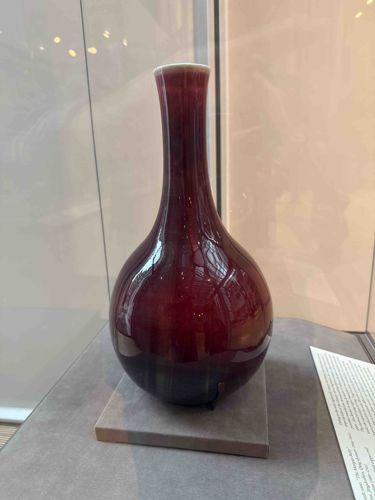
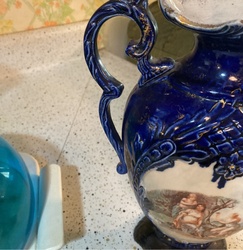
This is a classical Chinese bottle-form vase, characterized by its elegant and slender neck flaring gently to a slightly wider mouth, transitioning smoothly into a full, globular body. The vase is adorned with a rich, deep red 'sang de boeuf' (ox-blood) glaze, which exhibits a remarkable intensity and lustrous sheen. The color is not uniform; it subtly darkens towards the bottom of the body, creating a gradient effect, and some areas on the shoulder and body show slight variations in the depth of the red, suggesting the characteristic pooling and streaking of this type of glaze. The rim of the mouth is a distinguishing feature, revealing a pale, celadon-like or creamy white glaze 'draining' from the lip, a desirable effect known as 'strawberry lip' or 'white rim' in sang de boeuf glazes, indicating careful firing. The ceramic body itself appears to be of fine porcelain, given the thinness of the rim visible. No obvious chips, cracks, or repairs are discernible from the provided images, indicating good overall condition. The quality of the glaze, its uniformity aside from the intentional variations, and the classic form suggest a piece of considerable craftsmanship, likely from a significant period of Chinese ceramic production. The reflections on the glossy surface indicate a very smooth and well-fired glaze. Based on the form and glaze, it likely dates from the Qing Dynasty, possibly Kangxi, Yongzheng, or Qianlong periods, when such monochrome glazes were highly prized. It is displayed on a simple, modern-looking grey stand, suggesting it is a museum piece or part of a curated collection.
AI Appraisal Report
I have examined the Sang de Boeuf Glazed Bottle Vase and find it to be a superb example of classical Chinese ceramic art. The form is elegant and balanced, characteristic of high-quality Qing Dynasty production. The 'sang de boeuf' glaze is particularly impressive, displaying a rich, deep red with subtle variations, pooling, and streaking that are hallmarks of desirable examples. The 'strawberry lip' or 'white rim' effect, where the glaze thins to reveal a pale celadon or creamy white at the mouth, is a highly sought-after feature indicating precise firing control and adds significantly to its aesthetic appeal and authenticity. Condition appears excellent, with no visible chips, cracks, or repairs from the image provided. The high luster suggests a well-fired and preserved surface. However, a physical inspection is crucial to confirm the absence of restoration, hairline cracks, or firing imperfections not visible in photographs. Authenticity, especially dating to the Kangxi, Yongzheng, or Qianlong periods, would ideally be supported by provenance documentation (e.g., prior ownership, exhibition history) and, for definitive dating, scientific analysis such as thermoluminescence testing. Market demand for authentic, high-quality imperial monochrome glazes from the Qing Dynasty remains strong, with collectors keenly seeking pieces with exceptional glazes and classic forms. Rarity increases with age, condition, and the artistry of the glaze. Similar pieces, authenticated to the specific Qing imperial periods, have achieved significant prices at auction. While this piece possesses all the visual characteristics of a valuable antique, definitive authentication without physical examination and, ideally, provenance, limits a precise valuation. My valuation assumes, based on visual evidence, that it is an authentic and well-preserved piece from the mid-to-late Qing Dynasty, potentially a much earlier imperial kiln period.