AI Appraisal Estimate

AI-generated estimates · not official valuations

From the user

What was submitted

Photo and notes provided by the user — not generated by AI

Submitted item photo
Submitted photo · June 8, 2026

User's notes

No additional notes provided.

AI analysis below

AI appraisal

AI analysis & estimate

AI-Generated · Verify before acting

Everything below is generated by AI for informational purposes only. AI can make mistakes — the AI may misidentify items or misattribute them (artist, maker, brand, designer, origin, era). This is not an official valuation and should not be used for insurance, sale, tax, estate, legal, or lending purposes — or any decision requiring a certified appraisal. It is not an authoritative claim about any person, brand, or rights holder — do not share or rely on it as a factual statement about a third party. Always consult qualified professionals before making financial decisions.

Read the full disclaimer

AI Identification

·Not independently authenticated·Verify before acting

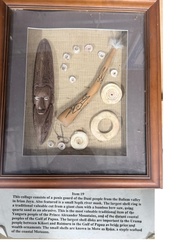
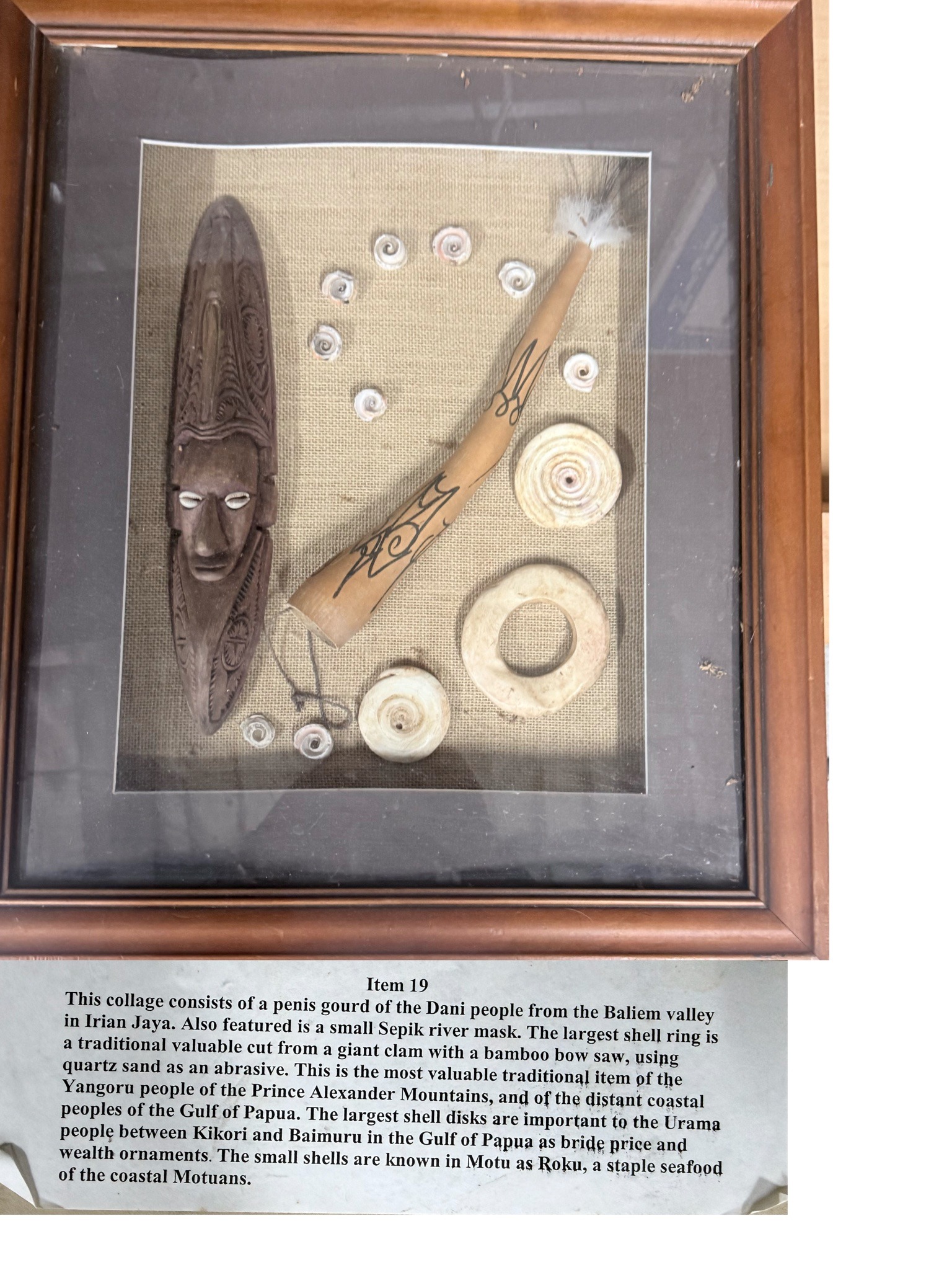
Papua New Guinea and Irian Jaya Tribal Art Shadow Box (Item 19)

Ethnographic Art & Artifacts

AI Estimated Value

·Not an official valuation·Verify before acting

$450 - $700

As of June 8, 2026

AI Item Analysis

·AI can make mistakes·Verify before acting
This shadow box display, identified as Item 19, contains a curated collage of traditional cultural artifacts from Papua New Guinea and Irian Jaya. The centerpiece elements include a 'Koteka' or penis gourd associated with the Dani people of the Baliem Valley, featuring a slender, curved, tan-colored organic form with dark decorative linear etchings and white feathers at the tip. Beside it sits a dark wood Sepik River mask, characterized by elongated proportions, almond-shaped cowrie shell eyes, and intricate tribal carvings on the forehead and chin. The assembly also features various shell currencies and ornaments: a large ring carved from a giant clam shell using traditional quartz sand abrasives, attributed to the Yangoru people; several large flat shell disks used as bride price by the Urama people; and numerous small operculum shells known as 'Roku' by the Motuans. The items are mounted on a tan burlap backing within a deep-set wooden frame with a glass front. The condition appears fair, though there is visible dust and debris accumulated at the bottom of the frame behind the glass, which is common for older shadow box mounts. The artifacts show signs of authentic traditional manufacture, such as the matte finish of the hand-carved wood and the natural irregularities in the ground-down clam shells, suggesting they are mid-to-late 20th-century ethnographic pieces.
AI Appraisal Report

·AI can make mistakes·Verify before acting
I have conducted a visual examination of Item 19, a shadow box collection of artifacts from Papua New Guinea and Irian Jaya. The assembly constitutes a diverse ethnographic 'survey' set. The centering Koteka exhibits authentic patina and traditional incised motifs, while the Sepik mask shows characteristic cowrie shell inlays and matte-finish carving consistent with mid-20th-century decorative or ceremonial-use objects. The Yangoru giant clam shell ring and Urama bride price disks add significant interest, as these materials are increasingly difficult to source due to CITES regulations on giant clam (Tridacna gigas). The condition is fair. The accumulation of debris and 'frass' at the bottom of the frame suggests possible organic degradation or past insect activity, common in tropical wood artifacts. This indicates the mount may need to be opened for cleaning and stabilization, which slightly tempers the valuation. The market for Melanesian art remains stable for authentic field-collected items, though 'tourist' versions of these objects are prevalent; the technical execution of the shell grinding and wood carving here suggests authentic manufacture. Limitations: This appraisal is based solely on digital imagery. Definitive authentication requires physical inspection to verify the density of the wood, the specific mineral mineralization of the shells, and to confirm the absence of modern tool marks (e.g., high-speed steel drills). Provenance documentation—such as collection dates or names of the original field collectors—would be necessary to elevate the value into a higher 'fine art' tier. Furthermore, microscopic examination of the debris is recommended to ensure no active infestation remains within the frame.

Get your items appraised

Instant estimates of your treasures with AI-powered appraisals

Browse More Appraisals