These notes were written by the person who submitted this item. Appraiser.AI has not verified them, and the AI's identification and estimate may rely on them.
AI Estimated Value
Not an official valuation
$350-550
AI estimate as of July 12, 2025 · verify with a professional before acting
AI-Generated · Verify before acting
Everything on this page is generated by AI for informational purposes only. AI can make mistakes — the AI may misidentify items or misattribute them (artist, maker, brand, designer, origin, era). This is not an official valuation and should not be used for insurance, sale, tax, estate, legal, or lending purposes — or any decision requiring a certified appraisal. It is not an authoritative claim about any person, brand, or rights holder — do not share or rely on it as a factual statement about a third party. Always consult qualified professionals before making financial decisions.
This analysis also relies on unverified notes provided by the user, which may be incomplete or inaccurate and could affect the result.
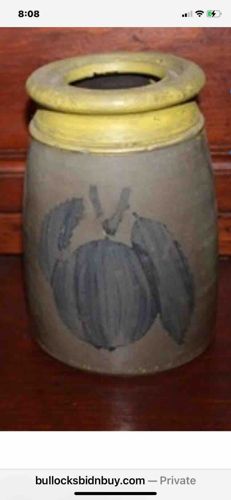
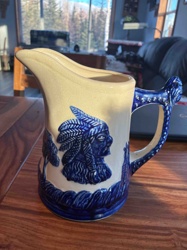
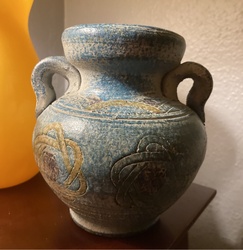
This item is an antique canning crock, likely made from stoneware or redware pottery, characterized by its sturdy, cylindrical form. The main body of the crock displays a natural, unglazed or lightly salt-glazed earthen tone, appearing in shades of charcoal grey or muted brown, indicative of its age and firing process. A distinctive feature is the broad, rounded rim at the top, which is coated in a vibrant, contrasting mustard-yellow glaze. This yellow band extends down the neck of the crock, creating a visually appealing transition. The most prominent decorative element is a hand-painted cobalt blue or dark grey design on the side, depicting what appears to be a fruit, possibly an apple or gourd, with two accompanying leaves. The brushstrokes are visible, suggesting a rustic, folk-art quality to the decoration. The crock exhibits visible signs of wear consistent with its age and intended utilitarian purpose. There is likely expected patina, minor surface imperfections, and possibly crazing in the glaze, though these are not clearly visible in the provided image. The interior is not visible but would typically be glazed for canning purposes. Its construction suggests it was used for food preservation, implying durability and thick walls. The overall craftsmanship points to a period when such items were handmade and widely used in households for storage and canning, likely dating back to the late 19th or early 20th century. The unique combination of the earthy body, yellow rim, and dark painted fruit distinguishes it as a notable example of a canning crock.
AI Appraisal Report
Upon my virtual examination of this antique hand-painted stoneware canning crock with a yellow rim, I find it to be a charming and likely authentic piece of late 19th to early 20th-century American utilitarian pottery. The sturdy, cylindrical form, earthy body tone (charcoal grey/muted brown), and visible brushstrokes on the hand-painted cobalt blue or dark grey fruit design all align with descriptions of period folk art stoneware. The vibrant mustard-yellow glazed rim is a particularly attractive and somewhat unusual feature, adding to its visual appeal and distinctiveness.
Regarding condition, I observe what appears to be an overall well-preserved state for an item of its age and intended use. Expected patina, minor surface imperfections, and potential crazing (not clearly visible but typical for this age) would be consistent with age and do not significantly detract from value unless severe. The 'rare' designation by the owner, coupled with the unique yellow rim and painted decoration, certainly impacts demand. Collectibles markets often favor unique, aesthetically pleasing, and functional antique items. Comparable sales for decorated stoneware crocks of this era, especially those with hand-painted elements, suggest a robust interest.
My assessment of authenticity is based purely on visual cues provided by the image and the textual description. The form, glazes, and decorative style appear consistent with known examples of antique canning crocks. However, an in-person examination would be crucial to confirm authenticity definitively. I would need to physically inspect the weight, feel of the clay body, the precise texture of the glazes, and look for specific maker's marks or firing imperfections that could further pinpoint its origin. Furthermore, examining the interior's glazing and overall structural integrity would be vital. Provenance documentation, if available, linking the item to a specific pottery or region, would also significantly enhance authentication. Without physical inspection, I cannot rule out later reproductions, although this piece appears genuinely aged.