Neoclassical Oil Painting of Roman Ruins in Ornate Gilt Frame
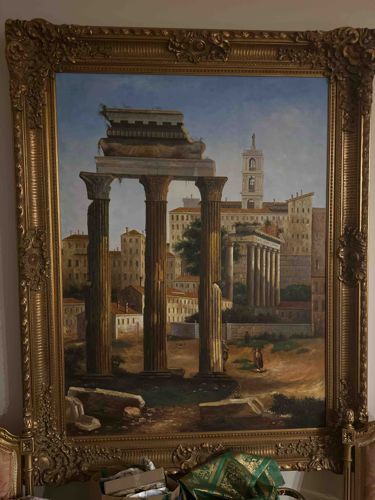
This large-scale oil on canvas depicts a 'Capriccio' or topographical view of Roman ruins, prominently featuring three fluted Corinthian columns supporting a partial entablature, likely inspired by the Temple of Vespasian and Titus or the Temple of Castor and Pollux in the Roman Forum. The composition includes secondary architectural ruins in the background, a bell tower, and multi-story Mediterranean-style buildings under a soft blue sky. The color palette is dominated by earthy siennas, ochres, and muted greens, typical of 18th or 19th-century academic landscape traditions. The painting is housed in an exceptionally large and elaborate giltwood or gilded composition frame. The frame features heavy rocaille ornamentation, including shell motifs (coquilles) at the centers and corners, acanthus leaf flourishes, and a beaded inner liner. The frame shows a rich gold-leaf or gold-paint finish with a dark bolus or patina in the recessed areas, enhancing the depth of the carvings. The overall construction suggests a high-quality decorative piece, possibly mid-to-late 19th century or a very high-quality 20th-century revival. Note some minor dust accumulation and potential superficial cracking (craquelure) consistent with age, though the canvas appears taut and well-preserved. There are no visible signatures in this view, though the style emulates the grand tour paintings of artists like Giovanni Paolo Panini.
AI-Generated Appraisal Disclaimer
Estimated Value
$4,500 - $6,500
Basic Information
Category
Fine Art - Paintings
Appraised On
February 24, 2026
Estimated Value
$4,500 - $6,500
Item Description
This large-scale oil on canvas depicts a 'Capriccio' or topographical view of Roman ruins, prominently featuring three fluted Corinthian columns supporting a partial entablature, likely inspired by the Temple of Vespasian and Titus or the Temple of Castor and Pollux in the Roman Forum. The composition includes secondary architectural ruins in the background, a bell tower, and multi-story Mediterranean-style buildings under a soft blue sky. The color palette is dominated by earthy siennas, ochres, and muted greens, typical of 18th or 19th-century academic landscape traditions. The painting is housed in an exceptionally large and elaborate giltwood or gilded composition frame. The frame features heavy rocaille ornamentation, including shell motifs (coquilles) at the centers and corners, acanthus leaf flourishes, and a beaded inner liner. The frame shows a rich gold-leaf or gold-paint finish with a dark bolus or patina in the recessed areas, enhancing the depth of the carvings. The overall construction suggests a high-quality decorative piece, possibly mid-to-late 19th century or a very high-quality 20th-century revival. Note some minor dust accumulation and potential superficial cracking (craquelure) consistent with age, though the canvas appears taut and well-preserved. There are no visible signatures in this view, though the style emulates the grand tour paintings of artists like Giovanni Paolo Panini.

Get Your Items Appraised
Instant estimates of your treasures with AI-powered instant appraisals