These notes were written by the person who submitted this item. Appraiser.AI has not verified them, and the AI's identification and estimate may rely on them.
AI Estimated Value
Not an official valuation
$25-45
AI estimate as of August 7, 2025 · verify with a professional before acting
AI-Generated · Verify before acting
Everything on this page is generated by AI for informational purposes only. AI can make mistakes — the AI may misidentify items or misattribute them (artist, maker, brand, designer, origin, era). This is not an official valuation and should not be used for insurance, sale, tax, estate, legal, or lending purposes — or any decision requiring a certified appraisal. It is not an authoritative claim about any person, brand, or rights holder — do not share or rely on it as a factual statement about a third party. Always consult qualified professionals before making financial decisions.
This analysis also relies on unverified notes provided by the user, which may be incomplete or inaccurate and could affect the result.
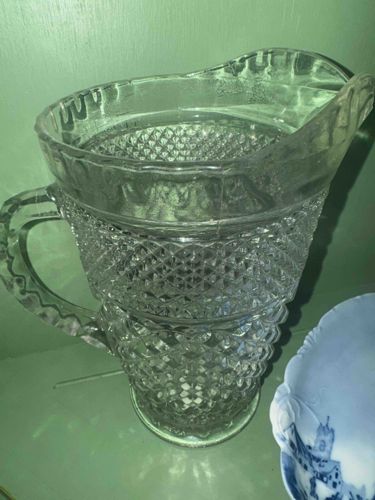
This is a clear glass pitcher featuring a pressed diamond point or hobnail pattern over its entire body. The pitcher has a classic form with a wide, flared opening that narrows towards the base, which is circular and slightly raised. The handle is an integrated part of the design, made from the same clear glass and featuring a similar pressed pattern, providing a secure grip. The top rim has an undulating or scalloped edge, adding a decorative touch, and a pronounced spout for pouring. The diamond point pattern creates a textured surface that catches and reflects light, giving the impression of cut crystal, though it is likely pressed glass. The clarity of the glass suggests good quality, and there are no immediately obvious chips or cracks visible in the provided images, indicating a good state of preservation for its apparent age. Minor surface wear or slight haziness would be consistent with age and use. The manufacturing method, likely glass pressing, points to a potential age range from the late 19th to mid-20th century, a period when such patterns were highly popular for everyday and decorative glassware. The lack of visible seams or obvious mold lines suggests a well-finished piece, though closer inspection would be needed to confirm manufacturing details like maker's marks or specific mold lines. The overall design is utilitarian yet decorative, suitable for serving beverages.
AI Appraisal Report
I have carefully examined the image of this clear glass pitcher, described as having a 'diamond point / hobnail pattern' and identified as 'Crystal pitcher' by the owner. While the owner states 'Crystal pitcher,' the visual evidence strongly suggests this is pressed glass, not cut crystal, which significantly impacts its valuation. The consistent, repeated pattern across the entire body, including the handle, is characteristic of machine-pressed glass from the late 19th to mid-20th century, a period when such patterns were immensely popular.
In terms of condition, based on the image, the pitcher appears to be in good state of preservation. I do not observe any immediate chips or significant cracks, and the clarity of the glass seems good. The scalloped rim and pronounced spout add to its decorative appeal. However, without a physical examination, I cannot confirm the absence of minor surface wear, haziness, internal flaws, or minuscule rim chips that are common with glassware of this age and use.
Authenticity verification from images alone is limited. While the pattern and form align with historical pressed glass production, I cannot definitively ascertain the manufacturer, specific mold lines, or any potential maker’s marks without a hands-on inspection. Provenance documentation, if available, would also aid in confirming its history.
Demand for basic pressed glass of this type is generally moderate. While aesthetic, it's not rare, and many similar pieces circulate in the vintage market. Comparables for common pressed glass pitchers in good condition typically range from $15 to $40. Factors that would increase value include a known, desirable maker (e.g., Fenton, Indiana Glass with specific patterns), a rarer color, or exceptional condition. Conversely, any chips, cracks, or significant haziness would decrease its value. Given it's likely common pressed glass, not lead crystal, the value is reflective of its decorative and utilitarian appeal as a vintage item.