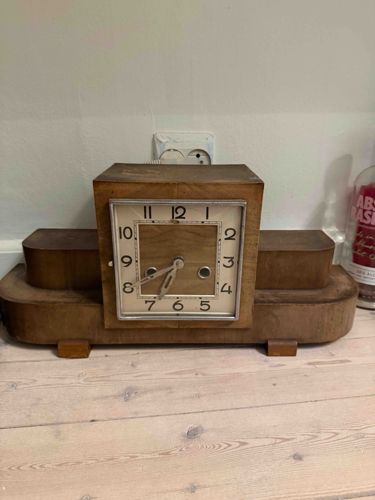
Art Deco Wooden Mantel Clock
Antique Clocks and Horology

Art Deco Wooden Mantel Clock

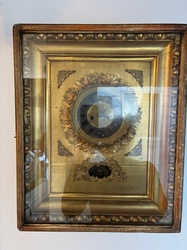
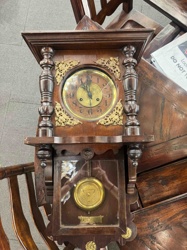
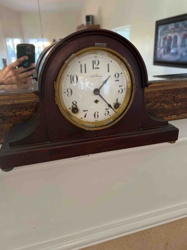
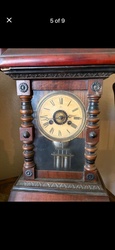
This is a mid-20th century Art Deco style mantel clock featuring a stepped, symmetrical wooden case with rounded corners. The case appears to be constructed from a light-to-medium toned wood, possibly walnut or oak veneer, showcasing a fine vertical grain. The central clock face is square with a silver-toned metal bezel. The dial features high-contrast Arabic numerals in a stylized Art Deco font, set against a cream-colored outer ring. The inner square of the dial repeats the wood finish of the case. It has two winding holes, suggesting a mechanical movement with strikes or chimes. The hands are tapered with an open-cell design typical of the 1930s-1940s. Condition-wise, the wood shows significant surface wear, including scuffs on the top surface, dust accumulation, and a dulling of the original finish. There are visible small chips and edge wear consistent with age. The metal bezel shows some pitting and oxidation. The clock rests on two simple block feet. While no maker's mark is visible on the dial, the geometric architecture is characteristic of European industrial design from the interwar period, likely British or German in origin.

Estimated Value

$100 - $185

Basic Information

Category

Antique Clocks and Horology

Appraised On

December 24, 2025

Estimated Value

$100 - $185

Item Description

This is a mid-20th century Art Deco style mantel clock featuring a stepped, symmetrical wooden case with rounded corners. The case appears to be constructed from a light-to-medium toned wood, possibly walnut or oak veneer, showcasing a fine vertical grain. The central clock face is square with a silver-toned metal bezel. The dial features high-contrast Arabic numerals in a stylized Art Deco font, set against a cream-colored outer ring. The inner square of the dial repeats the wood finish of the case. It has two winding holes, suggesting a mechanical movement with strikes or chimes. The hands are tapered with an open-cell design typical of the 1930s-1940s. Condition-wise, the wood shows significant surface wear, including scuffs on the top surface, dust accumulation, and a dulling of the original finish. There are visible small chips and edge wear consistent with age. The metal bezel shows some pitting and oxidation. The clock rests on two simple block feet. While no maker's mark is visible on the dial, the geometric architecture is characteristic of European industrial design from the interwar period, likely British or German in origin.
Get Your Items Appraised

Instant estimates of your treasures with AI-powered instant appraisals

Browse More Appraisals