AI Appraisal Estimate

AI-generated estimates · not official valuations

From the user

What was submitted

Photo and notes provided by the user — not generated by AI

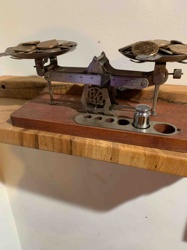
Submitted item photo
Submitted photo · June 13, 2026

User's notes

No additional notes provided.

AI analysis below

AI appraisal

AI analysis & estimate

AI-Generated · Verify before acting

Everything below is generated by AI for informational purposes only. AI can make mistakes — the AI may misidentify items or misattribute them (artist, maker, brand, designer, origin, era). This is not an official valuation and should not be used for insurance, sale, tax, estate, legal, or lending purposes — or any decision requiring a certified appraisal. It is not an authoritative claim about any person, brand, or rights holder — do not share or rely on it as a factual statement about a third party. Always consult qualified professionals before making financial decisions.

Read the full disclaimer

AI Identification

·Not independently authenticated·Verify before acting

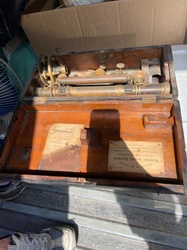
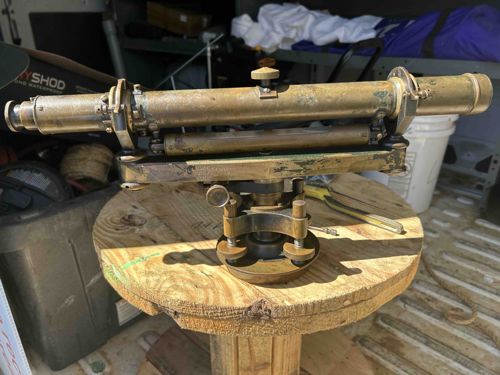
Vintage Brass Surveyor’s Wye Level

Antique Scientific Instruments

AI Estimated Value

·Not an official valuation·Verify before acting

$350 - $550

As of June 13, 2026

AI Item Analysis

·AI can make mistakes·Verify before acting
This is a vintage precision engineering instrument known as a 'Wye level,' used for surveying and civil engineering tasks to establish horizontal lines and measure elevation. The instrument is primarily constructed of brass, which has developed a significant aged patina ranging from deep golds to dark oxidation and green verdigris spots. The assembly consists of a long sighting telescope resting on Y-shaped supports (wyes), held in place by hinged clips. Parallel to the telescope is a secondary cylindrical spirit level vial, which appears to be intact but clouded. The base features a circular leveling plate with four knurled leveling screws and a central spindle for rotational adjustment. Notable features include fine-adjustment knobs for focusing and leveling, indicating high-quality mechanical craftsmanship from the late 19th to early 20th century. The condition shows heavy signs of environmental exposure and lack of maintenance; there is visible surface pitting, significant tarnish, and traces of old lubricants. While the mechanical components appear structurally sound, the optical clarity cannot be confirmed, and the overall finish suggests it has been stored in a damp or non-climate-controlled environment. Such instruments were hallmarks of Victorian-era surveying, often manufactured by firms like Keuffel & Esser or W. & L. E. Gurley, though a specific maker’s stamp is not clearly visible in this orientation.
AI Appraisal Report

·AI can make mistakes·Verify before acting
I have examined the visual data for this brass Wye level, an essential tool of late 19th-century geodetic surveying. The instrument displays the structural characteristics of high-end American makers like W. & L. E. Gurley or Keuffel & Esser. My assessment confirms the item is likely an authentic period piece rather than a reproduction, supported by the specific wear patterns on the knurled screws and the genuine verdigris oxidation on the brass. However, the condition is problematic. The telescope shows significant pitting and environmental tarnish. While the mechanical integrity of the wye clips and leveling head appears intact, the cloudiness in the spirit vial and potential internal lens delamination (fungus) significantly detract from its functional value. The market for antique surveying instruments remains steady for pieces in 'as found' condition, though collectors prioritize items with legible maker’s marks and original mahogany transit cases, neither of which are confirmed here. Similar unpolished wye levels without cases have recently realized between $300 and $600 at specialized scientific instrument auctions. The lack of a visible signature on the crossbar or eyepiece reduces its 'top-tier' desirability. Final valuation is limited by the digital nature of this inspection. A physical examination is required to check for 'frozen' adjustments, rack-and-pinion smoothness, and crosshair integrity. To fully authenticate the piece as a specific manufacturer, I would need to find the serial number usually located on the leveling head or limb. Provenance documentation, such as the original surveyor’s logbooks, would provide a significant premium to the final value.

Get your items appraised

Instant estimates of your treasures with AI-powered appraisals

Browse More Appraisals