AI Appraisal Estimate

AI-generated estimates · not official valuations

From the user

What was submitted

Photo and notes provided by the user — not generated by AI

Submitted item photo
Submitted photo · June 20, 2026

User's notes

No additional notes provided.

AI analysis below

AI appraisal

AI analysis & estimate

AI-Generated · Verify before acting

Everything below is generated by AI for informational purposes only. AI can make mistakes — the AI may misidentify items or misattribute them (artist, maker, brand, designer, origin, era). This is not an official valuation and should not be used for insurance, sale, tax, estate, legal, or lending purposes — or any decision requiring a certified appraisal. It is not an authoritative claim about any person, brand, or rights holder — do not share or rely on it as a factual statement about a third party. Always consult qualified professionals before making financial decisions.

Read the full disclaimer

AI Identification

·Not independently authenticated·Verify before acting

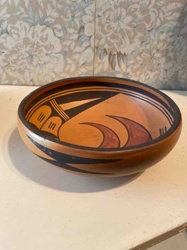
Acoma or Zia Pueblo Polychrome Terracotta Bowl

Native American Pottery / Fine Arts & Collectibles

AI Estimated Value

·Not an official valuation·Verify before acting

$450.00 - $650.00

As of June 20, 2026

AI Item Analysis

·AI can make mistakes·Verify before acting
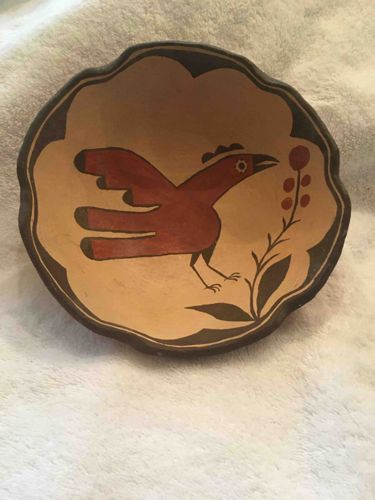
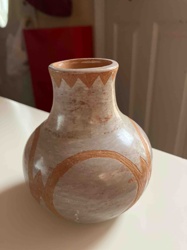
This is a hand-coiled terracotta pottery bowl, characteristic of Native American Pueblo craftsmanship, likely from the Acoma or Zia Pueblo traditions of New Mexico. The piece features a shallow, open form with an unusual scalloped or ruffled rim edge, displaying a high level of manual dexterity in its construction. The interior surface is treated with a traditional cream-to-tan slip, serving as a canvas for the polychrome decoration. The central motif is a stylized bird, often referred to as a Zuni or Acoma bird, rendered in a warm russet-red oxide with black mineral paint outlines and accents on the wing feathers and tail. Adjacent to the bird is a floral or botanical element with red berries and black leaves. The entire composition is framed by a bold, wide black banded border that follows the undulating contours of the scalloped rim. Regarding condition, the piece shows a soft, aged patina with mild surface abrasions and small flakes to the mineral pigment, particularly around the high points of the ruffled rim. There are no obvious large cracks or repairs visible in the primary image. The style and execution suggest a mid-20th-century origin, showcasing the transition between traditional utility and decorative art for the tourist trade. The hand-painted linework is expressive but maintains the symbolic geometry typical of Southwestern indigenous art.
AI Appraisal Report

·AI can make mistakes·Verify before acting
Upon visual examination of this polychrome terracotta bowl, I have identified it as a significant piece of Southwestern Puebloan pottery, likely of Acoma origin, dating to the mid-20th century. The scalloped rim is a distinctive feature often produced for the high-end tourist market during the 1940s–1960s. The execution of the parrot or 'Acoma Bird' motif shows competent hand-painting with traditional mineral pigments, and the cream slip displays the characteristic 'crazing' and soft patina associated with aged Acoma clay. The condition appears commensurate with age, showing expected minor pigment loss on the rim’s high points, which serves to confirm its history of handling rather than being a modern reproduction. The market for mid-century Pueblo pottery remains stable, with specific interest in pieces that depart from standard geometric forms into more expressive, ruffled shapes. Comparable pieces of this size and period typically fluctuate between $400 and $700 depending on the signature and provenance. This piece’s value is bolstered by the integrity of the central bird motif, though slightly tempered by the surface abrasions. Note: This appraisal is based strictly on photographic evidence. A definitive authentication requires an in-person physical inspection to assess the weight, temper (crushed sherd or sand), and 'ping' of the clay to ensure it was traditionally fired and not kiln-fired. Furthermore, the absence of a visible signature necessitates provenance documentation or a search for a faint pencil mark on the base. Scientific testing, such as thermoluminescence, is usually reserved for pre-contact artifacts and is not warranted here, but a hands-on review of the slip’s texture is essential to confirm it isn't a contemporary replica using synthetic pigments.

Get your items appraised

Instant estimates of your treasures with AI-powered appraisals

Browse More Appraisals