AI estimate as of December 4, 2025 · verify with a professional before acting
AI-Generated · Verify before acting
Everything on this page is generated by AI for informational purposes only. AI can make mistakes — the AI may misidentify items or misattribute them (artist, maker, brand, designer, origin, era). This is not an official valuation and should not be used for insurance, sale, tax, estate, legal, or lending purposes — or any decision requiring a certified appraisal. It is not an authoritative claim about any person, brand, or rights holder — do not share or rely on it as a factual statement about a third party. Always consult qualified professionals before making financial decisions.
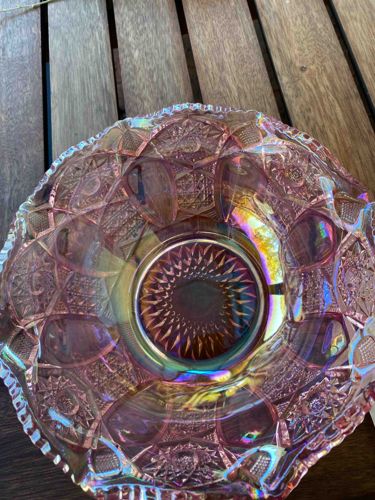
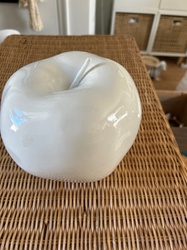
This item is a round, iridescent pink carnival glass bowl, likely dating from the early 20th century, specifically the Art Nouveau or Edwardian era. The glass exhibits a striking opalescent shimmer, displaying a spectrum of colors including dominant pinks, purples, blues, and yellows under different lighting conditions due to its metallic salt coating, a hallmark of carnival glass. The bowl features a complex, pressed-glass pattern characterized by a central medallion with a concentric spiral or starburst motif. Radiating outwards from the center are sections with geometric patterns, including diamond shapes, squares, and possibly stylized floral or starburst impressions within those larger sections. The rim of the bowl appears to be scalloped or pie-crusted, adding to its decorative appeal. The overall construction suggests it was mass-produced using a mold, typical for carnival glass. There are no obvious signs of chips, cracks, or significant damage visible in the provided image, indicating a relatively good condition for its age. The intricate detailing and the vibrant iridescence are key quality indicators, showcasing the manufacturing capabilities of the period. While no specific maker's marks are visible in the image, such patterns were common among prominent carnival glass manufacturers like Fenton, Northwood, or Imperial Glass Companies. The bowl's vibrant coloration and detailed patterns make it a highly decorative and collectible piece.
AI Appraisal Report
Based on my visual examination of the Iridescent Pink Carnival Glass Bowl, I assess its condition as relatively good to excellent for its age, showing no obvious chips, cracks, or significant damage. The vibrant opalescent shimmer, displaying a spectrum of pinks, purples, blues, and yellows, is characteristic of well-preserved carnival glass from the early 20th century. Authenticity appears consistent with typical mass-produced pressed carnival glass from the Art Nouveau or Edwardian eras. The intricate multi-patterned design, with its central medallion and radiating geometric and possibly floral motifs, is a strong indicator of its decorative appeal.
Market conditions for carnival glass are generally stable, with demand for exceptional pieces remaining steady. While common patterns can be found readily, the 'pink' iridescence, though often a variant of peach or amberina produced through specific firing and metallic salt applications, tends to be more sought after than more ubiquitous marigold or green examples. Comparables for similar elaborate pink iridescent bowls by makers like Fenton, Northwood, or Imperial typically range from $60 to $150, depending on specific pattern rarity and condition. The absence of a visible maker's mark prevents attributing it to a premium manufacturer without further inspection, thus affecting the higher end of the value.
Factors impacting its value positively include its appealing aesthetic, good condition, and the desirable 'pink' iridescence. The lack of a definitive maker's mark and the widespread production of similar patterns prevent it from achieving significantly higher values reserved for rare patterns or marked pieces. For full authentication and to definitively attribute a maker, in-person examination, including black light testing for repairs and closer inspection of pattern details, would be beneficial. Provenance documentation, though unlikely for such an item, would also add value.