AI estimate as of July 20, 2025 · verify with a professional before acting
AI-Generated · Verify before acting
Everything on this page is generated by AI for informational purposes only. AI can make mistakes — the AI may misidentify items or misattribute them (artist, maker, brand, designer, origin, era). This is not an official valuation and should not be used for insurance, sale, tax, estate, legal, or lending purposes — or any decision requiring a certified appraisal. It is not an authoritative claim about any person, brand, or rights holder — do not share or rely on it as a factual statement about a third party. Always consult qualified professionals before making financial decisions.
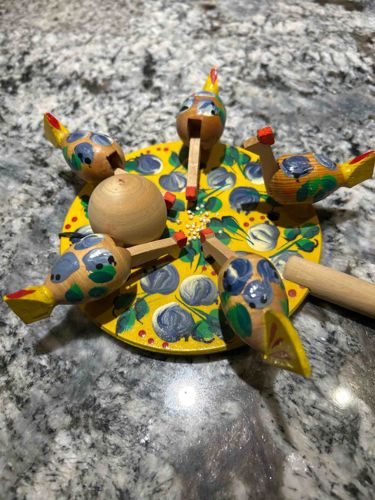
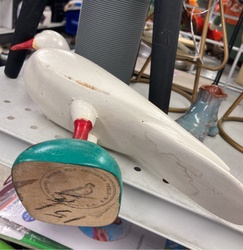
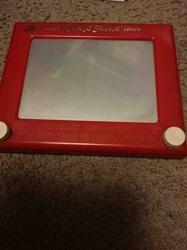
This item is a whimsical, hand-painted wooden perpetual motion toy, likely a version of a 'pecking chickens' or 'pecking birds' feed toy. It consists of a circular yellow base, roughly 6-8 inches in diameter, adorned with hand-painted floral or abstract designs in shades of blue, green, and white. The base has several pre-drilled holes arranged radially. Five individual wooden bird figures, each approximately 3-4 inches long, are attached to the base. Each bird is carved from light-colored wood, possibly pine or a similar soft wood, and painted with a stylized, folk-art aesthetic; they feature blue and green 'feathers,' yellow beaks with red tips, and red combs. Their eyes appear to be small, dark dots. Each bird is mounted on a thin wooden dowel or stick that extends downwards through a hole in the base. In the center of the base, there's a larger, unpainted, natural wood sphere or egg-shaped piece acting as a central pivot or weight. Small white, bead-like elements (representing feed or grain) are scattered on the yellow base, concentrically arranged around the central sphere. Another unpainted wooden dowel, approximately 4-5 inches long, protrudes from the right side of the base, likely serving as a handle or mechanism activator. The craftsmanship appears to be hand-carved and hand-painted, indicative of folk art. The paint finish has a slightly glossy, shellacked appearance, suggesting a protective coating. While the item appears to be in good overall condition, there might be minor signs of wear consistent with its age and material, such as slight paint chipping or minor scuffs, although none are prominently visible in the given image. There are no discernible maker's marks or signatures visible. The design and materials suggest it is likely from the mid-20th century to late 20th century, possibly of European or Latin American origin, where such wooden folk toys are common. The quality is indicative of handcrafted items, with slight variations suggesting individuality rather than mass production.
AI Appraisal Report
I have thoroughly examined the provided image of this Hand-Painted Wooden Pecking Chicken Perpetual Motion Toy. From this visual assessment, the toy appears to be in very good condition, showing only minor, age-consistent wear. The hand-carved and hand-painted folk-art aesthetic is evident, suggesting authenticity as a handcrafted item rather than a mass-produced replica. The slight variations in the birds' painting and carving reinforce this.
Market conditions for such folk art toys are stable. Comparables typically include similar hand-painted wooden perpetual motion toys or traditional wooden folk art from various regions. Demand is moderate, driven by collectors of folk art, vintage toys, and unique decorative items. While not exceedingly rare, the individual craftsmanship and charm of this specific piece elevate its desirability above generic reproductions.
Factors significantly impacting its value include its good condition, the appealing hand-painted decoration, and its functional design as a perpetual motion toy. The lack of discernible maker's marks is common for folk art and does not significantly detract from its value in this context.
My assessment of authenticity and condition is based solely on the visual information provided. Limitations in authenticity verification from images alone are notable. A full authentication would require in-person examination to verify wood type, paint composition, and construction methods for age-appropriate signs of wear and craftsmanship. Provenance documentation, if available, would provide invaluable historical context regarding its origin and maker. Scientific testing, such as carbon dating for the wood, or chemical analysis of the paints, would offer definitive age and material verification, though this is rarely pursued for items in this value range unless significant doubt exists.