Chinese Export Imperial Dragon Carved Armchair
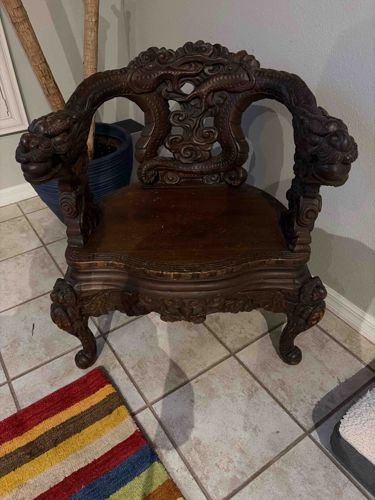
This is a highly ornate, hand-carved armchair, likely of Chinese export origin dating from the late 19th up to the mid-20th century. The piece is constructed from a dark-stained hardwood, possibly rosewood or zitan, possessing a deep chocolate-brown patina with a matte finish. The most striking physical characteristic is the continuous horseshoe backrest and arms, which are intricately carved to represent a pair of serpentine dragons. The dragons' heads serve as the arm terminals, featuring bulging eyes and open mouths, while their scaled bodies coil down to form the splat and frame. The wide, contoured seat is solid wood with a visible grain, showing significant wear and finish loss along the front edge where a user's legs would rest. The apron and four Cabriole-style legs are also heavily carved with auspicious clouds or scrolling foliate motifs, ending in ball-and-claw or stylized foo-dog feet. Notable condition issues include minor scuffs across the seat surface, potential structural thinning in the openwork carving of the backrest, and overall dust accumulation within the deep recesses of the carving. The craftsmanship suggests a high level of artisanal skill, although the absence of visible reign marks or signatures suggests it was produced in a commercial workshop intended for the high-end export market. This style is often referred to as 'dragon furniture' and was popular in the West during the late Qing Dynasty period.
AI-Generated Appraisal Disclaimer
Estimated Value
$2,500 - $4,500
Basic Information
Category
Antique Furniture
Appraised On
February 15, 2026
Estimated Value
$2,500 - $4,500
Additional Details Provided By Owner
User Provided Information
Chair
Item Description
This is a highly ornate, hand-carved armchair, likely of Chinese export origin dating from the late 19th up to the mid-20th century. The piece is constructed from a dark-stained hardwood, possibly rosewood or zitan, possessing a deep chocolate-brown patina with a matte finish. The most striking physical characteristic is the continuous horseshoe backrest and arms, which are intricately carved to represent a pair of serpentine dragons. The dragons' heads serve as the arm terminals, featuring bulging eyes and open mouths, while their scaled bodies coil down to form the splat and frame. The wide, contoured seat is solid wood with a visible grain, showing significant wear and finish loss along the front edge where a user's legs would rest. The apron and four Cabriole-style legs are also heavily carved with auspicious clouds or scrolling foliate motifs, ending in ball-and-claw or stylized foo-dog feet. Notable condition issues include minor scuffs across the seat surface, potential structural thinning in the openwork carving of the backrest, and overall dust accumulation within the deep recesses of the carving. The craftsmanship suggests a high level of artisanal skill, although the absence of visible reign marks or signatures suggests it was produced in a commercial workshop intended for the high-end export market. This style is often referred to as 'dragon furniture' and was popular in the West during the late Qing Dynasty period.
Related Tags
Get Your Items Appraised
Instant estimates of your treasures with AI-powered instant appraisals