AI Appraisal Estimate

AI-generated estimates · not official valuations

From the user

What was submitted

Photo and notes provided by the user — not generated by AI

Submitted item photo
Submitted photo · June 19, 2026

User's notes

No additional notes provided.

AI analysis below

AI appraisal

AI analysis & estimate

AI-Generated · Verify before acting

Everything below is generated by AI for informational purposes only. AI can make mistakes — the AI may misidentify items or misattribute them (artist, maker, brand, designer, origin, era). This is not an official valuation and should not be used for insurance, sale, tax, estate, legal, or lending purposes — or any decision requiring a certified appraisal. It is not an authoritative claim about any person, brand, or rights holder — do not share or rely on it as a factual statement about a third party. Always consult qualified professionals before making financial decisions.

Read the full disclaimer

AI Identification

·Not independently authenticated·Verify before acting

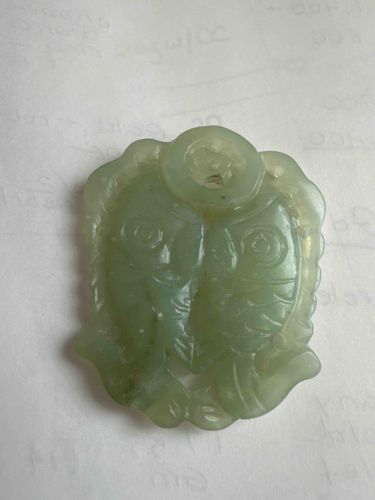
Carved Celadon Jade Double Fish Pendant

Asian Art and Antiques - Jewelry & Lapidary

AI Estimated Value

·Not an official valuation·Verify before acting

$450.00 - $650.00

As of June 19, 2026

AI Item Analysis

·AI can make mistakes·Verify before acting
This item is a hand-carved pendant crafted from celadon-colored jadeite or nephrite jade, showcasing a classic 'double fish' (Shuangyu) motif. The pendant measures approximately 4 to 5 centimeters in length and features a pale, translucent greenish-grey hue with subtle milky inclusions typical of natural stone. The design depicts two stylized fish joined at the center, facing each other with tails fanning out at the bottom, topped by a circular bail or bi-disk element for suspension. The carving employs low-relief techniques to define scales, fins, and large circular eyes, with openwork piercing to delineate the outer silhouette and central separation. Symbolically, the double fish represents marital harmony and abundance in Chinese culture. The condition appears fair to good; there are visible surface abrasions and internal fractures (calcification) consistent with age and handling. The carving depth is moderate, indicating traditional hand-tooling rather than modern high-precision machining. While no maker's marks are present, the stylistic execution and patina suggest a production date ranging from the late 19th to the early 20th century (Late Qing to Republic period). The soft, waxy luster of the stone indicates it has likely been handled over time, enhancing its character.
AI Appraisal Report

·AI can make mistakes·Verify before acting
I have conducted a remote visual analysis of this carved celadon jade 'Double Fish' (Shuangyu) pendant. Based on the waxy luster and pale greenish-grey hue, the material is consistent with nephrite jade. The carving exhibits characteristics of traditional hand-tooling from the Late Qing to early Republic period (c. 1890-1930), specifically in the slightly asymmetrical low-relief scales and the soft rounding of the edges which suggests natural 'skin' wear from handling. The condition is fair to good; however, visible internal fractures and minor calcification (whitish opacity) suggest significant age and potentially some environmental stress. In the current market for Asian lapidary arts, late 19th-century nephrite pendants remain desirable for collectors of symbolic motifs, though the lack of vivid coloration (such as 'mutton fat' or high-emerald jadeite) limits its peak valuation. Similar pieces from the Republic period typically hammer between $400 and $700 at regional specialty auctions. The 'Shuangyu' motif represents a perennially popular symbol of marital bliss and abundance, maintaining steady demand in the secondary market. Please note that this appraisal is based on image analysis alone. A definitive valuation is subject to physical inspection to rule out modern polymer treatments or 'B-grade' jadeite enhancements. Scientific testing via infrared spectroscopy or specific gravity measurement would be required to confirm the exact mineral species and lack of artificial dyes. Documentation of provenance (previous ownership) would also be necessary to solidify the attribution to the Late Qing period.

Get your items appraised

Instant estimates of your treasures with AI-powered appraisals

Browse More Appraisals