AI Appraisal Estimate

AI-generated estimates · not official valuations

From the user

What was submitted

Photo and notes provided by the user — not generated by AI

Submitted item photo
Submitted photo · May 18, 2026

User's notes

No additional notes provided.

AI analysis below

AI appraisal

AI analysis & estimate

AI-Generated · Verify before acting

Everything below is generated by AI for informational purposes only. AI can make mistakes — the AI may misidentify items or misattribute them (artist, maker, brand, designer, origin, era). This is not an official valuation and should not be used for insurance, sale, tax, estate, legal, or lending purposes — or any decision requiring a certified appraisal. It is not an authoritative claim about any person, brand, or rights holder — do not share or rely on it as a factual statement about a third party. Always consult qualified professionals before making financial decisions.

Read the full disclaimer

AI Identification

·Not independently authenticated·Verify before acting

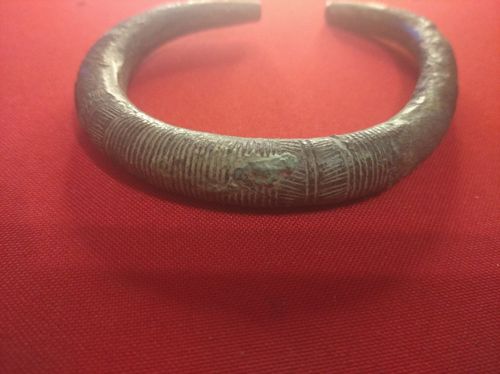
African Bronze or Copper Alloy Torque Manilla

Ethnographic Jewelry and Primitive Currency

AI Estimated Value

·Not an official valuation·Verify before acting

$450 - $700

As of May 18, 2026

AI Item Analysis

·AI can make mistakes·Verify before acting
This item is an antique African open-ended torque or penannular bracelet, likely a form of 'Manilla' currency or a prestigious personal adornment. Crafted from a heavy copper alloy or solid bronze, the piece features a thick, rounded cross-section that tapers slightly toward the blunt, un-flanged terminals. The exterior surface is extensively decorated with deep, hand-incised rhythmic linear patterns and cross-hatched geometric bands, indicative of West African metallurgical traditions, possibly from the Benin, Igbo, or Yoruba cultures. The metal exhibits a rich, dark aged patina ranging from deep chocolate brown to charcoal black, with significant areas of verdigris (green oxidation) visible, particularly in the recessed textured areas. This surface crusting and oxidation suggest long-term exposure to the elements or burial. The construction appears to be solid cast metal, demonstrating significant weight and high-quality tribal craftsmanship. Based on the stylistic elements and heavy oxidation, this piece likely dates from the late 19th to the early 20th century. Condition issues include surface abrasions consistent with age, heavy mineralized deposits, and general wear to the incised details from use and handling.
AI Appraisal Report

·AI can make mistakes·Verify before acting
I have carefully examined the provided images of this West African copper alloy torque. The item displays stylistic hallmarks consistent with the 'Leg Bracelets' or larger penannular currency forms of the Igbo and Oron peoples of South-Eastern Nigeria. The heavy, hand-incised geometric patterns and rhythmic striations are characteristic of late 19th to early 20th-century craftsmanship. The surface exhibits a multi-layered patina; the presence of localized verdigris and mineralized crusting suggests authentic age and potential burial, or long-term storage in a humid environment. In the current market for ethnographic art, there is steady demand for 'primitive' currency and prestigious adornment, though values for manillas vary significantly based on size and specific regional design. Comparables sold at specialized ethnographic auctions typically range from $300 for common types to over $1,000 for verified 19th-century pieces with prestigious provenance. The value of this piece is bolstered by the density of the incised decoration and the integrity of the solid casting. However, a significant limitation of this digital examination is the inability to verify the weight/density or the chemical composition of the alloy. Modern reproductions often use 'chemical aging' to mimic oxidation. To finalize this authentication, I would require an in-person examination to check for 'active' vs. 'stable' corrosion and to inspect for tool marks under magnification. Original provenance documentation or collection history would also significantly enhance the market value. Without scientific testing (such as X-ray fluorescence) to confirm metallurgical consistency with the 19th-century bronze trade, this appraisal assumes authenticity based on visual stylistic indicators alone.

Get your items appraised

Instant estimates of your treasures with AI-powered appraisals

Browse More Appraisals