Prehistoric Chert Bifacial Scraping Tool / Knife
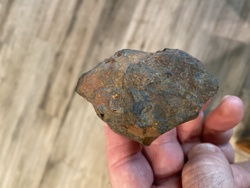
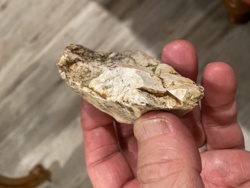
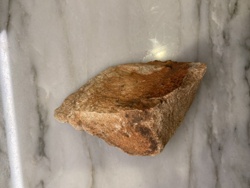
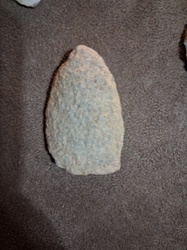
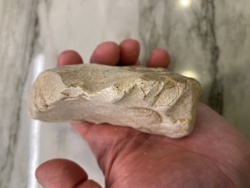
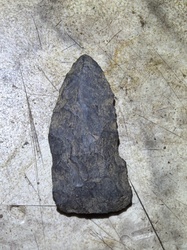
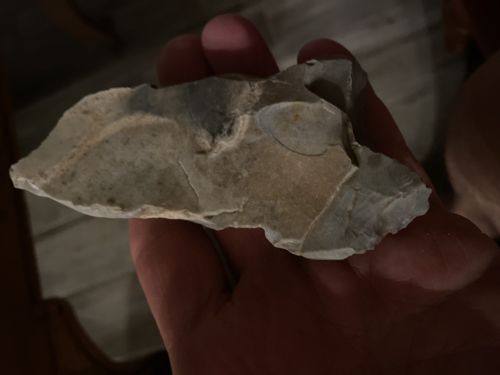
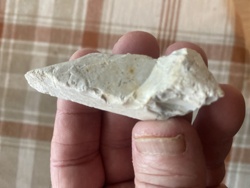
This specimen is a prehistoric lithic artifact discovered in Guthrie, Oklahoma, exhibiting characteristics of a bifacial knife or scraping tool. Measuring approximately 3.5 inches in length and 1.5 inches in width, the item is constructed from locally sourced chert, likely Florence or Kay County chert common to the region. The material displays a variegated color palette consisting of matte greys, tans, and creamy whites with darker mineral inclusions. The construction reveals clear evidence of percussion flaking, with large, shallow flake scars across the dorsal surface used to thin the core. The distal end tapers to a semi-pointed tip, while the proximal end appears somewhat thicker, possibly intended for hand-mounting or hafting. Condition-wise, the piece shows significant 'field wear' including ancient edge-damage or Step-fracturing likely caused by heavy-duty scraping against bone or wood. There is a visible patina and mineral accumulation within the flake scars, indicating long-term burial and authenticity. The craftsmanship is utilitarian rather than refined, suggesting a Late Archaic to Woodland period tool (approx. 3,000 to 1,000 years old). The presence of cortex (original outer stone rind) on portions of the surface indicates this was repurposed from a large flake rather than a fully reduced core, marking it as an expedient tool of significant archaeological interest for the plains region.
AI-Generated Appraisal Disclaimer
Estimated Value
$45.00 - $75.00
Basic Information
Category
Native American Artifacts / Prehistoric Lithics
Appraised On
February 17, 2026
Estimated Value
$45.00 - $75.00
Additional Details Provided By Owner
User Provided Information
Prehistoric chert knife 3.5" in length and 1.5" in width found in Guthrie, OK on our property
Item Description
This specimen is a prehistoric lithic artifact discovered in Guthrie, Oklahoma, exhibiting characteristics of a bifacial knife or scraping tool. Measuring approximately 3.5 inches in length and 1.5 inches in width, the item is constructed from locally sourced chert, likely Florence or Kay County chert common to the region. The material displays a variegated color palette consisting of matte greys, tans, and creamy whites with darker mineral inclusions. The construction reveals clear evidence of percussion flaking, with large, shallow flake scars across the dorsal surface used to thin the core. The distal end tapers to a semi-pointed tip, while the proximal end appears somewhat thicker, possibly intended for hand-mounting or hafting. Condition-wise, the piece shows significant 'field wear' including ancient edge-damage or Step-fracturing likely caused by heavy-duty scraping against bone or wood. There is a visible patina and mineral accumulation within the flake scars, indicating long-term burial and authenticity. The craftsmanship is utilitarian rather than refined, suggesting a Late Archaic to Woodland period tool (approx. 3,000 to 1,000 years old). The presence of cortex (original outer stone rind) on portions of the surface indicates this was repurposed from a large flake rather than a fully reduced core, marking it as an expedient tool of significant archaeological interest for the plains region.
Get Your Items Appraised
Instant estimates of your treasures with AI-powered instant appraisals