AI Appraisal Estimate

AI-generated estimates · not official valuations

From the user

What was submitted

Photo and notes provided by the user — not generated by AI

Submitted item photo
Submitted photo · June 21, 2026

User's notes

No additional notes provided.

AI analysis below

AI appraisal

AI analysis & estimate

AI-Generated · Verify before acting

Everything below is generated by AI for informational purposes only. AI can make mistakes — the AI may misidentify items or misattribute them (artist, maker, brand, designer, origin, era). This is not an official valuation and should not be used for insurance, sale, tax, estate, legal, or lending purposes — or any decision requiring a certified appraisal. It is not an authoritative claim about any person, brand, or rights holder — do not share or rely on it as a factual statement about a third party. Always consult qualified professionals before making financial decisions.

Read the full disclaimer

AI Identification

·Not independently authenticated·Verify before acting

Victorian Era Dome-Top Immigrant Trunk

Antique Furniture & Travel Collectibles

AI Estimated Value

·Not an official valuation·Verify before acting

$150 - $300

As of June 21, 2026

AI Item Analysis

·AI can make mistakes·Verify before acting
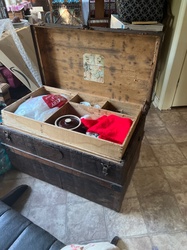
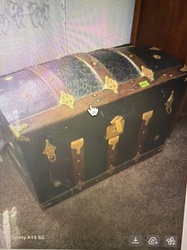
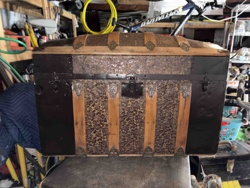
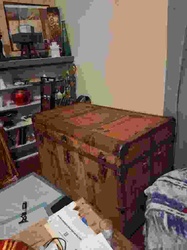
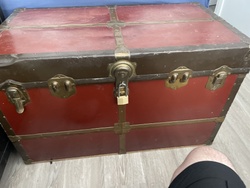
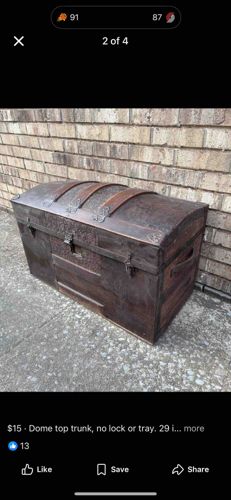
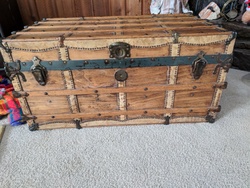
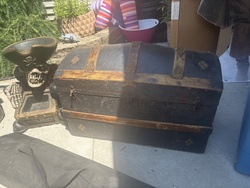
This is a classic late 19th-century Victorian dome-top trunk, often referred to as a camel-back or immigrant trunk, dating approximately between 1870 and 1890. The trunk features a distinctive barrel-stave construction with curved wooden slats reinforcing the rounded lid. The body is constructed of solid wood and is likely covered in embossed patterned tin (crystalled tin) which shows a dark, aged patina and significant surface oxidation consistent with its 100+ year age. It is reinforced with heavy-gauge iron or steel banding and decorative cast-metal hardware. The corners are protected by metal bumpers, and the lid is secured by a central brass-toned lock mechanism (missing its housing or key, as per the description) flanked by two side latches. The trunk exhibits thick leather side handles, oriented horizontally, which appear worn but intact. Condition-wise, the exterior shows heavy weathering, surface rust on the metal components, and significant fading of the original finish. There is visible wear along the base edges and minor surface abrasions across the pressed metal skin. No specific maker's mark is visible in the photograph, though the style is typical of American manufacture from companies such as Taylor or M. Maier. Its craftsmanship is sturdy, designed for the rigors of 19th-century steamship and rail travel.
AI Appraisal Report

·AI can make mistakes·Verify before acting
I have virtually examined this Victorian dome-top immigrant trunk, dating approximately 1870–1890. The barrel-stave construction and embossed 'crystalled' tin skin are quintessential of American manufacturers like M. Maier or Taylor. The item displays high authenticity based on the age-consistent oxidation on the iron banding and the authentic wear on the leather handles. However, condition is a significant limiting factor; the heavy surface rust, missing lock components, and weathered metal skin suggest it has been kept in a non-climate-controlled environment, such as a barn or attic. While the structural integrity remains sturdy, the loss of original interior lithographs or the 'glitter' finish of the tin reduces its appeal to high-end collectors. Market demand for dome-top trunks has softened recently, as their non-flat tops prevent them from being used as functional coffee tables—a primary driver for the antique trunk market. Comparables for unrestored trunks in this condition typically hammer between $100 and $250 at regional auctions. A fully restored version of this same model could command $600+, but the cost of professional restoration currently outweighs the market value increase. Limitations: This appraisal is based solely on visual evidence. A physical inspection is required to determine the presence of active dry rot or wood-boring insect damage in the base, which would significantly devalue the piece. Furthermore, I cannot verify if the interior tray is original or present, nor can I confirm the maker without finding a patent bridge or labeled hardware during a tactile search. Full authentication would require provenance documentation or a physical search for a manufacturer's label often hidden under the lid paper.

Get your items appraised

Instant estimates of your treasures with AI-powered appraisals

Browse More Appraisals