Item analysis
From the user
What was submitted
Photo and notes provided by the user — not generated by AI

Submitted photo · May 15, 2026
User's notes
No additional notes provided.
AI analysis below
AI appraisal
AI analysis & estimate
AI-Generated · Verify before acting
Everything below is generated by AI for informational purposes only. The AI may misidentify items or misattribute them (artist, maker, brand, designer, origin, era). This is not an official valuation and is not an authoritative claim about any person, brand, or rights holder — do not share or rely on it as a factual statement about a third party. Always consult qualified professionals before making financial decisions.
Estimated value
$45.00 - $85.00
As of May 15, 2026
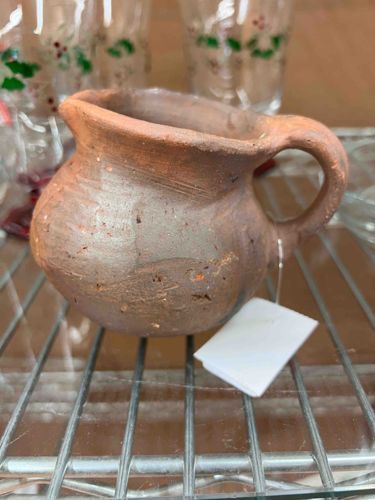
This is a small, hand-formed earthenware or terracotta pitcher, likely a functional miniature or a cream jug. The vessel features a bulbous, slightly asymmetrical body that flows into a wide, flared neck with a small, integrated pouring spout. A thick, looped handle is attached at the rim and mid-shoulder. The material is a coarse-grained red/brown clay with visible temper, indicating a low-fire production process. Its surface is unglazed and displays a rustic, matte finish with significant variations in color, ranging from deep earth red to grayish-tan, possibly due to uneven firing temperatures. Notable features include faint horizontal ribbing on the upper shoulder, likely a result of the coil-building or throwing process. The condition is aged and weathered; the rim and spout exhibit small chips and roughness, and there are numerous surface pits, abrasions, and dark encrustations (possibly soil or carbon deposits). These aesthetic qualities suggest a folk-art origin or a utilitarian archaeological-style piece, possibly dating from the late 19th to mid-20th century. The piece lacks discernible maker's marks, focusing purely on functional, vernacular craftsmanship.
Detailed appraisal report
I have examined the digital representation of this hand-formed terracotta pitcher and find it to be a charming example of vernacular folk pottery. The vessel's primitive construction—evidenced by the asymmetrical bulbous body and coarse-grained clay—suggests a utilitarian or transitional origin, likely from a Mediterranean, Mexican, or Middle Eastern tradition where such forms were used for cream or oil. The visible horizontal ribbing and handle attachment indicate manual coil-building or slow-wheel techniques. The uneven firing oxidation and surface encrustations provide a sense of age, though the condition shows significant wear, including rim chips and surface abrasions that diminish structural integrity but enhance its rustic appeal.
In the current market, unglazed folk-art miniatures of this type are common. High-end collectors typically seek authenticated ancient artifacts or pieces with specific regional provenance (e.g., signed Southern folk pottery). Given the lack of a maker's mark and the presence of minor damage, the value remains modest, primarily appealing to decorative buyers or early pottery enthusiasts. Comparable pieces at auction frequently sell within the double-digit range.
A definitive valuation is limited by the digital nature of this inspection. From images alone, I cannot distinguish between 19th-century utilitarian wear and modern 'distressing' used in reproduction. A full authentication would require a physical examination to test the hardness of the clay and the nature of the encrustations. To confirm a more significant historical date, provenance documentation or thermoluminescence (TL) testing would be required. Without such evidence, I must classify this as a decorative ethnographic object of the late 19th to mid-20th century.
Get your items appraised
Instant estimates of your treasures with AI-powered appraisals