Traditional Granite Rotary Hand Mill (Quern)
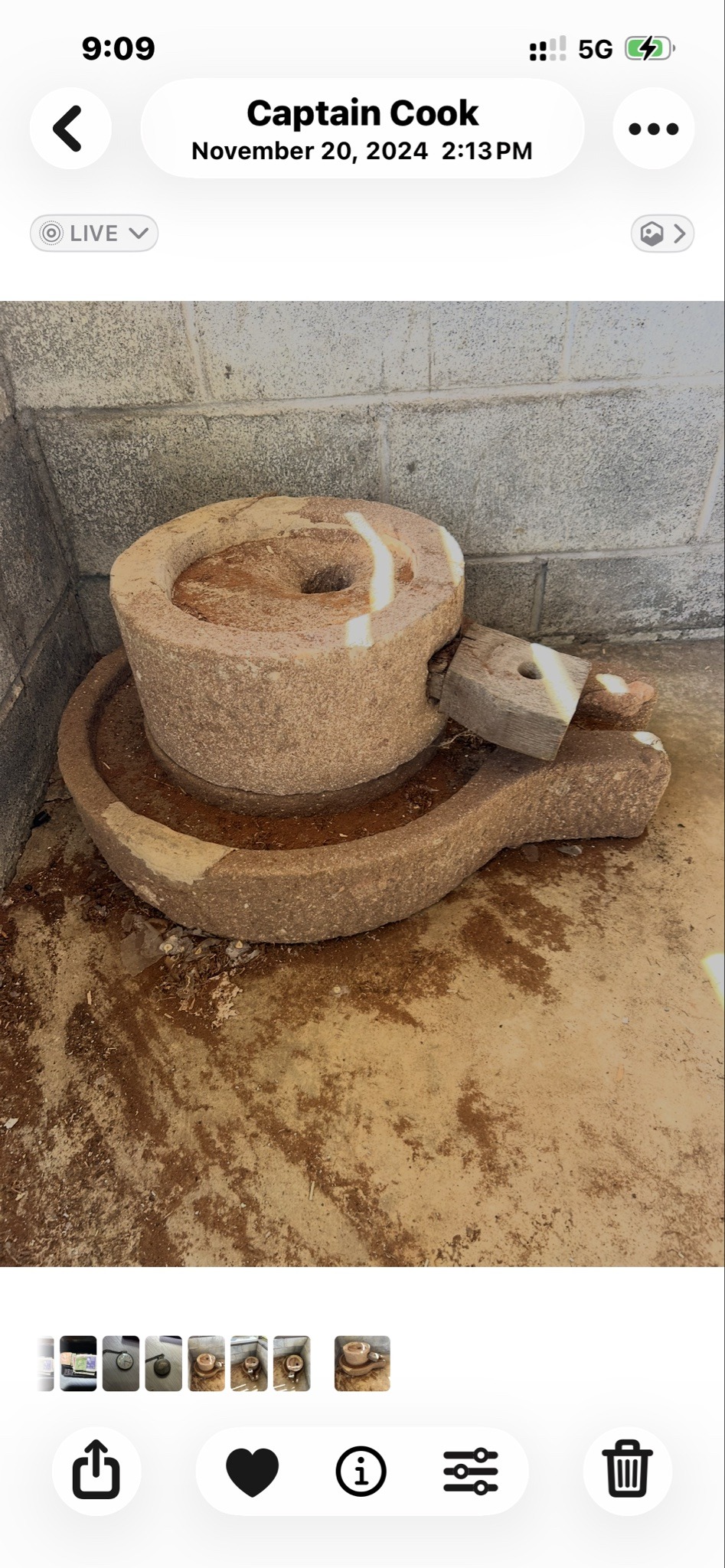
This is a large, traditional stone rotary hand mill, historically used for grinding grains or spices. The item is constructed from a coarse-grained, speckled granite or similar igneous rock, characterized by its beige, grey, and reddish-brown hues. The mill consists of a stationary bowl-shaped base (the bedstone) with a protruding spout for the ground materials to exit, and a heavy cylindrical upper stone (the runner stone). The runner stone features a central deep well or 'eye' where grain would be poured. A notable feature is the presence of an original, weathered wooden handle attachment remains fitted into a square socket on the side of the runner stone. The stone surfaces exhibit significant pitting, biological staining, and surface dirt, consistent with long-term outdoor or utility storage. There are visible chips along the upper rim and spout, indicating heavy use and age. The craftsmanship is utilitarian and robust, likely dating back to the late 19th or early 20th century, though the design is ancient. The overall condition is fair to good for a primitive agricultural tool, showing a natural patina of age without catastrophic structural cracks.
AI-Generated Appraisal Disclaimer
Estimated Value
$450.00 - $650.00
Basic Information
Category
Antique Agricultural & Kitchen Tools
Appraised On
May 10, 2026
Estimated Value
$450.00 - $650.00
Item Description
This is a large, traditional stone rotary hand mill, historically used for grinding grains or spices. The item is constructed from a coarse-grained, speckled granite or similar igneous rock, characterized by its beige, grey, and reddish-brown hues. The mill consists of a stationary bowl-shaped base (the bedstone) with a protruding spout for the ground materials to exit, and a heavy cylindrical upper stone (the runner stone). The runner stone features a central deep well or 'eye' where grain would be poured. A notable feature is the presence of an original, weathered wooden handle attachment remains fitted into a square socket on the side of the runner stone. The stone surfaces exhibit significant pitting, biological staining, and surface dirt, consistent with long-term outdoor or utility storage. There are visible chips along the upper rim and spout, indicating heavy use and age. The craftsmanship is utilitarian and robust, likely dating back to the late 19th or early 20th century, though the design is ancient. The overall condition is fair to good for a primitive agricultural tool, showing a natural patina of age without catastrophic structural cracks.
Related Tags
Get Your Items Appraised
Instant estimates of your treasures with AI-powered instant appraisals